
You need gutter clearance when debris restricts water flow, gutter repairs when the guttering is damaged or incorrectly supported, and both when those problems occur together. Overflow alone does not tell you which service to book: a blocked outlet and a failed joint need different work. When requesting a quote in 2026, describe where water escapes and ask for clearance and any repair work to be identified separately.
- Gutter clearance removes obstructions; gutter repairs address damaged joints, supports and sections.
- Overflow is a symptom, not proof that your gutters need replacing.
- Geyserclean provides gutter clearance in Milton Keynes; ask separately about any repair requirements.
- Check the outlet and downpipe before treating a clear gutter as a solved drainage problem.
Why this matters
Booking the wrong work leaves the original problem unresolved. Removing leaves will not close a cracked gutter, while replacing a joint will not remove a blockage farther along the drainage route.
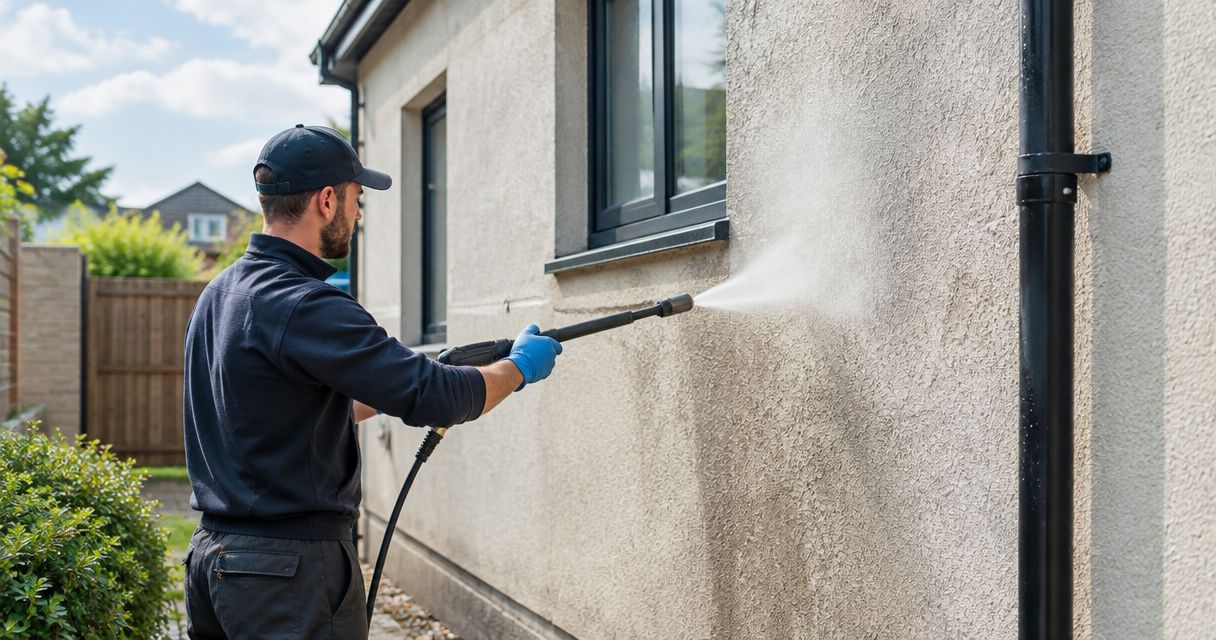
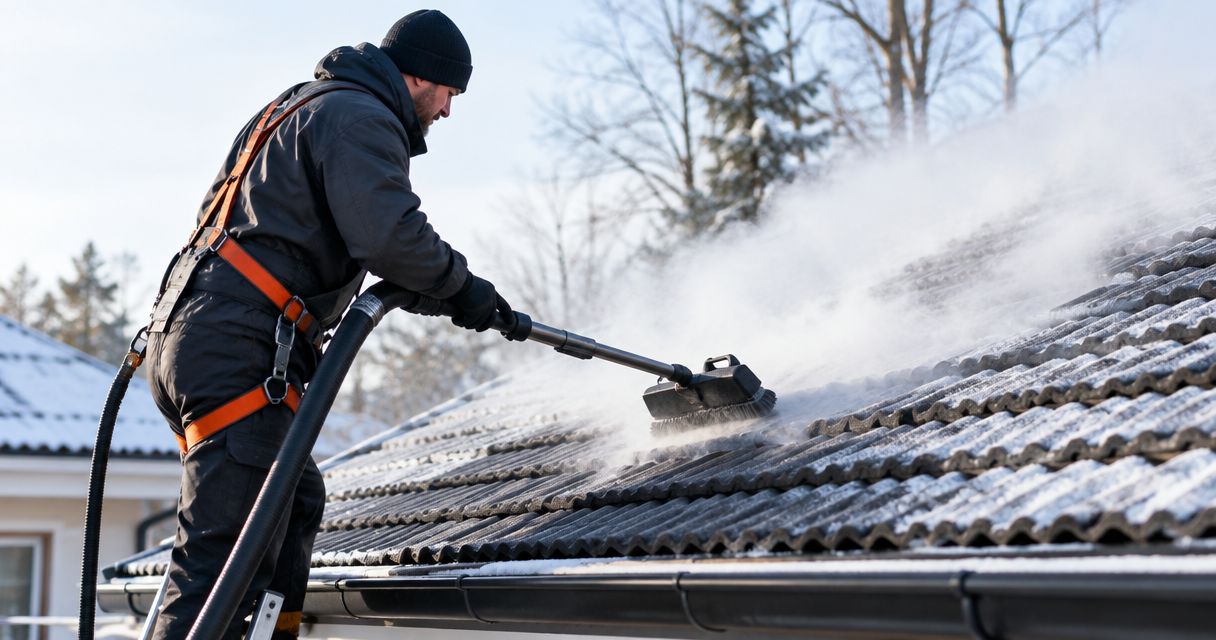
Geyserclean is suited to homeowners seeking gutter clearance in Milton Keynes and the surrounding Home Counties. Its stated services also include roof cleaning, render cleaning, driveway cleaning and patio cleaning. When contacting Geyserclean, describe the gutter problem rather than assuming that cleaning includes repairs.
Keep diagnosis separate from the service name. You want to know what is obstructed, what is defective and what the proposed work actually covers.
Gutter clearance or gutter repairs: which does your home need?
Start with the difference between an obstruction and a physical defect. The table below gives you a practical way to describe the symptoms, not a substitute for inspecting the affected guttering.
| Work | Best for | Useful signs | Main benefit | Limitation |
|---|---|---|---|---|
| Gutter clearance | Debris restricting drainage | Visible leaves, moss or vegetation; water backing up near an outlet | Removes material that obstructs water flow | Does not mend cracks, joints or brackets |
| Gutter repairs | Defective guttering or supports | Visible cracks, separated joints, loose brackets or sections holding water because of their alignment | Addresses the identified physical fault | Does not automatically include clearing debris or downpipes |
| Clearance and repairs | Blockage and damage together | Debris alongside a leaking joint, loose support or damaged section | Deals with both causes in a defined scope | Requires clarity about the order of work and who completes each task |
A joint that leaks during rain needs investigation, but the leak alone does not prove the seal has failed. Water backing up behind a restriction can also escape at joints.
Choose the work that addresses the cause, not simply the place where you see water. If debris prevents a useful inspection, clearance helps reveal what needs further attention.
When gutter clearance is the right starting point
Gutter clearance is the appropriate starting point when material inside the gutter or outlet restricts the route rainwater should follow. Leaves, twigs and loose roof moss are examples of material to look for from a safe position.
You do not need to identify every obstruction yourself. Tell the contractor whether water spills over a long section, collects near a corner or backs up close to a downpipe. Photographs taken during rain can help explain an intermittent problem, provided you take them safely from ground level.
Ask what the proposed clearance includes:
- Removal of debris from the gutter channels.
- Attention to outlets where water enters the downpipes.
- Assessment of suspected downpipe obstructions.
- A suitable check of water flow after the work.
- An explanation of defects noticed during clearance.
These are scope questions, not confirmed inclusions in every service. For a 2026 booking, get the agreed work in writing rather than relying on the phrase gutter cleaning alone.
The advantage of clearance is specific: it removes obstructions. Its limit is equally specific: an empty gutter can still leak, sag or drain incorrectly.
When gutter repairs are needed
Gutter repairs address a physical fault rather than accumulated material. Examples include cracked sections, disconnected fittings, failed joint seals and brackets that no longer hold the gutter in its intended position.
Ask the person assessing the guttering to identify the defect and explain the proposed correction. A description such as leaking corner is useful as an observation, but it does not explain whether the corner fitting, seal, alignment or nearby drainage restriction needs attention.
A repair recommendation should name the fault and the affected location. Ask whether the work involves adjusting, resealing or replacing a component, and whether adjacent sections need checking.
Repair work has a clear benefit when the defect is established. Its limitation is that fixing one component does not establish that the rest of the drainage route is clear.
Do not assume a gutter-clearance provider also carries out repairs. Confirm responsibility before agreeing the work, particularly where another contractor will need to return.
When your home needs both clearance and repairs
Blockage and damage are not competing diagnoses. A gutter can contain debris and have a cracked fitting at the same time.
Where both are present, ask for a sensible sequence: remove the obstruction, inspect the exposed guttering, address confirmed defects and check drainage where appropriate. Access and condition determine how the work is organised; this is not an instruction to climb up and investigate yourself.
Keep the scope divided into clearance and repairs even if one contractor undertakes both. That makes it easier to understand what has been completed and what remains unresolved.
Why gutter problems vary between properties
There is no single symptom that reliably separates every blockage from every defect. These factors explain why an assessment needs more than a photograph of water spilling over an edge:
- Debris location: material in a channel, outlet or downpipe affects different parts of the drainage route.
- Gutter condition: cracked sections and deteriorated joints need assessment independently of accumulated debris.
- Support and alignment: loose brackets or an unsuitable fall can leave water standing after clearance.
- Access: conservatories, extensions and awkward elevations affect how the guttering can be reached and inspected safely.
- Connected drainage: a clear gutter does not establish that its downpipe or the drainage beyond it is unobstructed.
- Rainfall conditions: note whether overflow occurs during ordinary rain or only during particularly heavy rainfall; that observation helps describe the problem without proving its cause.
An older gutter is not automatically beyond repair. Equally, cleaning is not a remedy for a visibly broken component. Base the decision on condition and function, not appearance alone.
How should you check the problem before booking?
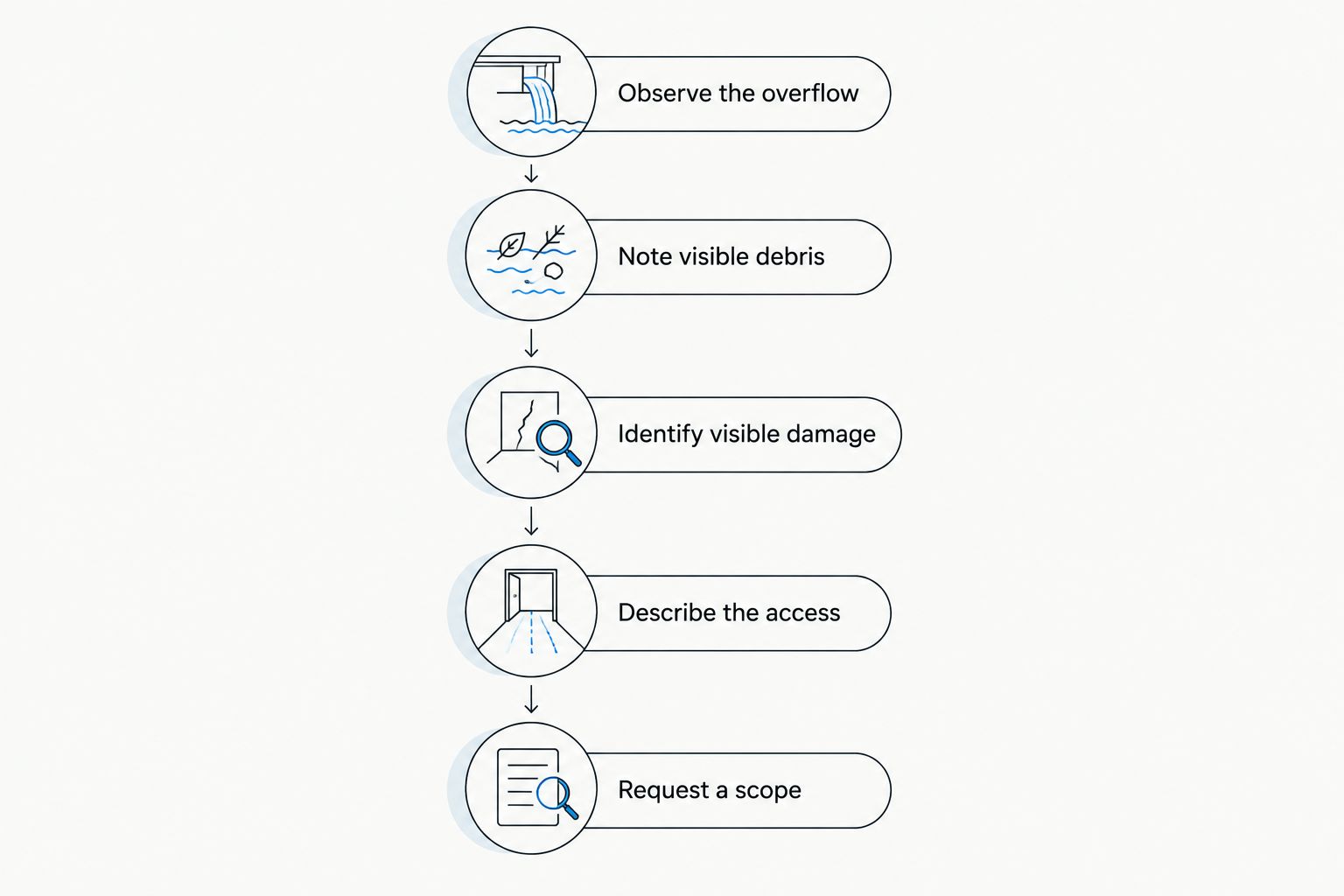
Use this ground-level sequence to prepare useful information for a contractor. Do not climb onto a roof, lean across a conservatory or use an improvised ladder position to obtain photographs.
Observe the overflow
Record where water appears during rain: over the front edge, beneath a joint, behind the gutter or around a downpipe connection. Describe the location using a recognisable feature, such as the rear bedroom window or garage corner.
Note visible debris
Look for leaves, vegetation and loose material visible from the ground. An apparently clear front edge does not establish that the gutter channel or outlet is clear.
Identify visible damage
Photograph obvious gaps, hanging sections or disconnected pipes without approaching anything unstable. Report what you can see; leave the diagnosis of seals, brackets and alignment to the assessment.
Describe the access
Mention conservatories, extensions, locked side gates and areas where access requires permission. For commercial premises or managed properties, identify who can authorise access and the proposed work.
Request a scope
Send the property address, photographs and a short account of what happens in rain. Ask for clearance, investigation and any proposed repairs to be distinguished in the written response.
Your photographs should help explain the problem, not require you to take a risk. A clear description from a safe position is more useful than a close-up obtained by unsafe access.
What should a written gutter quote explain?
For a 2026 quote, ask for the work to be described by location and task. Whole-house gutter clearance and attention to one overflowing corner are different scopes, even when both are described casually as gutter cleaning.
The written scope should let you answer these questions:
- Which elevations and gutter runs are included?
- Are outlets and suspected downpipe blockages included or assessed separately?
- How will access restrictions be handled?
- Are repairs included, excluded or subject to further inspection?
- What happens if clearance exposes a damaged fitting?
- What completion checks are proposed?
Do not treat a clean gutter channel as proof that the downpipe is clear. Read the guide to whether gutter clearance includes checking downpipes before comparing scopes.
Geyserclean provides gutter clearance, but its stated cleaning services do not establish a repair specification. Ask directly about any suspected defect rather than assuming that replacement fittings or joint repairs form part of the visit.
Send your property address and photos for a written quote. Include the affected elevation, when the overflow occurs and any restrictions on access.
Request a written gutter quote
Send your property address, photos and a description of the overflow or visible defect.
Do overflowing gutters always need replacing?
Overflowing gutters do not automatically need replacing. Debris, obstructed outlets and downpipe problems are among the causes that need checking before replacement is recommended.
Replacement needs its own justification, such as an identified condition problem that the proposed repair would not adequately address. Ask why clearance or a local repair is unsuitable rather than accepting overflow as the diagnosis.
Should gutters be checked before roof or render cleaning?
Check a known gutter problem before arranging roof cleaning or render cleaning. Tell the contractor about overflow, loose guttering and suspected drainage restrictions so the work can be planned around the property's condition.
Cleaning the roof or render does not repair defective guttering. For exterior cleaning booked in 2026, ask how the services will be sequenced and whether a separate repair needs completing first.
FAQ
What's the difference between gutter clearance and gutter repairs?
Gutter clearance removes material obstructing drainage; gutter repairs address physical faults such as cracked sections, failed joints or loose supports. A property can need both.
Why are my gutters still leaking after clearance?
Gutters can still leak after clearance because a physical defect or another drainage restriction remains. Ask for the outlet, downpipe, joints and alignment to be assessed rather than assuming more cleaning will solve it.
Does gutter clearance include repairing leaking joints?
Gutter clearance does not automatically include repairing leaking joints. Ask for repairs to be listed explicitly in the written scope before booking.
Can I tell from the ground whether a gutter is blocked?
Ground-level observations can reveal debris and overflow, but they cannot confirm the condition of the entire gutter or downpipe. Take photographs safely and request an assessment where the cause is unclear.
Can gutter repairs be done before clearance?
The right order depends on the defect, obstruction and safe access. Where debris hides the condition of the guttering, clearance helps establish what repairs are needed.
What should I send when requesting gutter clearance in 2026?
Send the property address, photographs and a description of where and when water escapes. Include access restrictions and ask whether outlets, downpipes and any repairs are covered.
Does Geyserclean provide gutter clearance in Milton Keynes?
Geyserclean provides gutter clearance for residential and commercial property owners in Milton Keynes and the surrounding Home Counties. Send the address and photos for a written quote, and identify suspected repairs separately.
One last thing
Ask what happens if the gutter still overflows after clearance. That question separates debris removal from diagnosing an unresolved drainage problem.
You are not asking for an unlimited repair promise. You are asking how the contractor will explain an obstruction, defect or access limitation that remains, so you can decide the next step without booking the same work again.