Re-sanding matters because cleaning can remove jointing sand from conventional block paving, and those filled joints help the blocks resist movement. For driveway cleaning in Milton Keynes, the right finish depends on the paving construction: replace lost sand in sand-jointed blocks, but do not apply the same treatment to resin-bound surfaces or mortared joints.
- Driveway cleaning Milton Keynes: re-sand conventional block paving where cleaning leaves jointing sand depleted.
- Geyserclean provides driveway cleaning; ask for a written quote that identifies your surface and the proposed joint treatment.
- Jointing sand supports interlock; it does not repair a sunken base, loose edging or broken blocks.
- Re-sand when the paving and joints are dry, using material appropriate to the paving system.
Driveway cleaning in Milton Keynes: why does re-sanding matter?
Re-sanding restores the jointing material that conventional block paving needs after cleaning removes it. Sand between the blocks contributes to interlock, helping neighbouring blocks work together under traffic rather than behaving as isolated pieces.
A clean surface is only part of the job. If the joints have been washed out, the driveway needs an assessment of how to restore them, not simply a final rinse and a photograph.
Geyserclean is a fit for Milton Keynes property owners seeking professional driveway cleaning with surface-specific advice. Ask for the cleaning method and any re-sanding work to be stated separately in the written quote.
| Driveway construction | Best for this joint treatment | Benefit | Limitation |
|---|---|---|---|
| Conventional sand-jointed block paving | Compatible jointing sand | Restores the material contributing to block interlock | Does not correct failed bedding or loose edge restraints |
| Paving with a proprietary jointing system | Treatment specified for that system | Keeps the repair matched to the existing construction | Ordinary dry sand is not a universal substitute |
| Slabs with mortared joints | Assessment and repair of damaged mortar | Addresses the actual joint construction | Brushing sand over failed mortar does not repair it |
| Resin-bound surfacing | Surface-specific cleaning assessment | Avoids treating a bonded surface as loose-jointed paving | Conventional block-paving re-sanding is not applicable |
Why this matters
For a driveway cleaning quote in 2026, judge the proposed finish as carefully as the cleaning method. A driveway can look much cleaner while still having depleted joints, loose blocks or damaged edging.
Re-sanding is maintenance, not reconstruction. It replaces suitable jointing material, but it cannot make an unstable foundation sound or straighten a driveway that has already sunk.
That distinction protects your expectations. You need to know whether the job is cleaning and joint replenishment, or whether paving repairs are needed before the finished surface will be satisfactory.
What does jointing sand actually do?
In conventional flexible block paving, the blocks, joints, bedding and edge restraints work together. Jointing sand helps transfer loads between adjoining blocks and limits their relative movement.
The sand is not merely a cosmetic line around each block. Where joints are depleted, restoring the correct material is part of maintaining the paving construction.
Do not confuse jointing sand with the bedding beneath the blocks. Adding sand from above is not a substitute for lifting and relaying a block where the bedding or support has failed.
Nor is a freshly sanded joint a permanent weed barrier. Seeds and organic debris can collect at the surface, so routine sweeping remains useful after the cleaning work is complete.
The practical test is joint condition, not colour. A brighter driveway with visibly empty joints still needs attention, while a stained driveway does not automatically need every joint stripped out.
How should cleaning and re-sanding be planned?
A sensible work sequence starts with identifying the surface and finishes with checking the joints. Do not select the cleaning equipment before establishing what the paving can tolerate.
- Surface check. Identify conventional block paving, mortared slabs, resin-bound surfacing or another construction. Note coatings and previous joint repairs.
- Condition check. Look for rocking blocks, settlement, cracked joints, loose edging and drainage problems. Separate cleaning requirements from repair requirements.
- Cleaning method. Choose the method for the material, age and condition. Control the cleaning process around joints, edges and adjacent surfaces.
- Drying check. Before applying dry jointing sand, confirm that the paving and joints are sufficiently dry for the material to enter properly.
- Joint finishing. Apply the compatible material and follow the paving or jointing manufacturer's instructions for filling, compaction and final inspection.
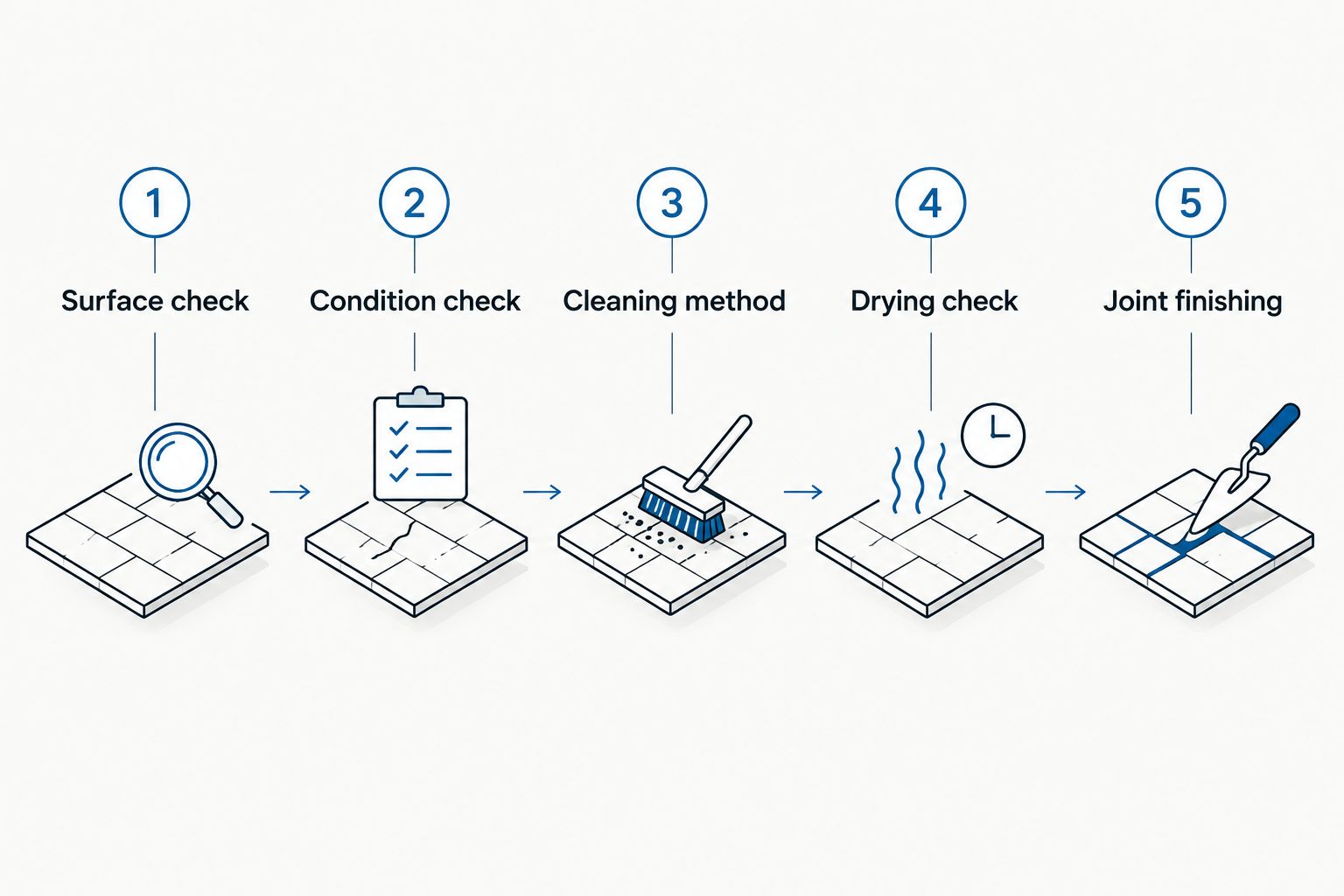
These are general planning principles, not a statement that every contractor includes every stage in a cleaning visit. Your written scope should explain which stages apply to your driveway and who is responsible for any repairs.
When should block paving be re-sanded?
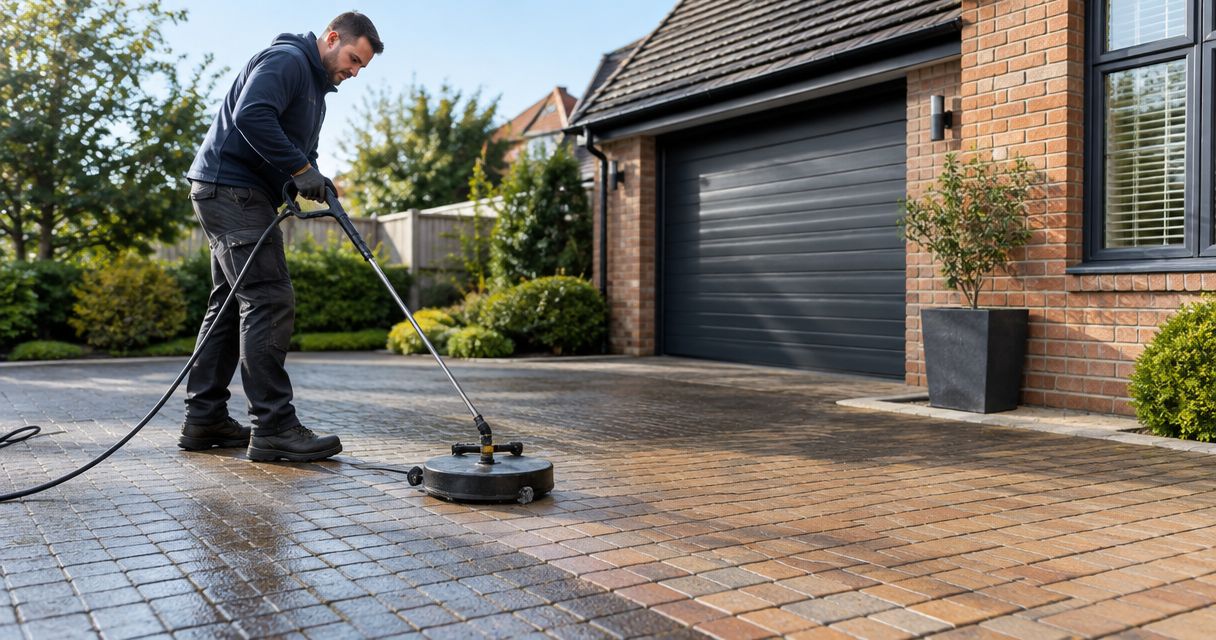
Re-sand conventional block paving when inspection shows that jointing sand has been lost or depleted. Cleaning is a useful point to assess this because dirt and growth can obscure the condition of the joints.
Do not assume that every cleaned driveway needs the same quantity of sand. Existing joint depth, block shape and the amount of material remaining all affect the work required.
The timing should follow surface conditions rather than a fixed appointment interval. Dry jointing sand needs dry conditions to flow into the joints; damp paving can leave it clinging to the surface instead.
For work booked in 2026, ask what happens if the cleaning day is suitable but the driveway is not dry enough for re-sanding. A planned return visit is clearer than an unexplained unfinished stage.
Why does the re-sanding requirement vary?
The postcode does not determine the jointing specification. The following factors explain why neighbouring Milton Keynes driveways can need different treatment:
- Paving construction: Sand-jointed blocks, mortared slabs and bonded surfaces require different approaches.
- Existing joint condition: Partly filled joints need a different assessment from extensively depleted or failed joints.
- Age and previous repairs: Mixed materials, replacement blocks and patched joints need checking before cleaning starts.
- Surface condition: Loose blocks, damaged edges and settlement identify repair issues that re-sanding alone cannot resolve.
- Cleaning method: The method and its application affect how much existing jointing material is disturbed.
- Drying conditions: Shade, rainfall and retained moisture affect when dry sand can be applied properly.
Ask the contractor to connect the proposed method to those observations. A specification that only says driveway cleaning leaves the joint treatment unresolved.
Is steam or pressure washing better before re-sanding?
Neither method is the right answer for every driveway. Material, condition, contamination and the existing jointing system should determine the cleaning approach.
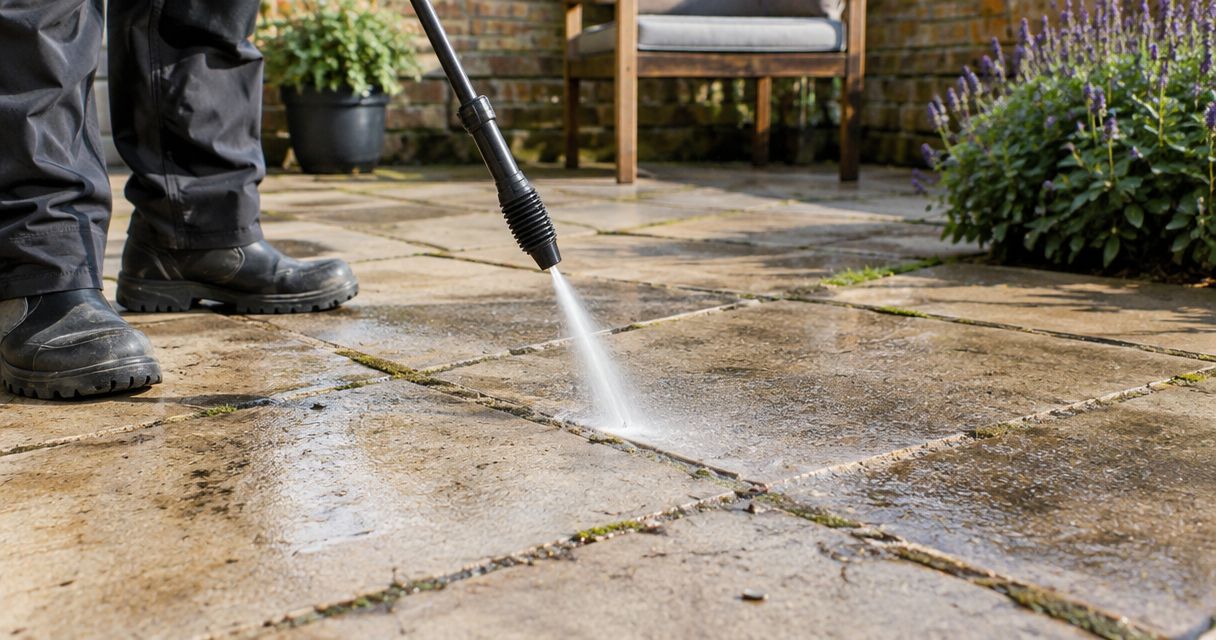
Pressure washing can remove surface dirt, but its application needs control around joints and vulnerable areas. Steam can be appropriate for some cleaning tasks, but heat is not automatically suitable for every paving material, coating or repair.
Softwashing also needs a surface-specific assessment. A treatment for organic growth does not replace missing joint material or repair loose paving.
Ask how the proposed method will treat the surface without unnecessarily disturbing sound joints. The useful answer explains the choice; it does not simply name a machine.
What should your written driveway cleaning quote include?
For a 2026 quote, ask for a defined area and a defined finish. Photographs help establish the starting point, but the contractor still needs to identify issues that photographs do not show clearly.
Your quote should address:
- The driveway material and areas included, including steps, paths or parking bays where relevant.
- The proposed cleaning method and any surface-specific limitations.
- Whether re-sanding is included, excluded or subject to inspection after cleaning.
- The intended jointing material and any requirements for drying or a return visit.
- How nearby planting, drainage points and adjoining surfaces will be considered.
- Which defects require repair rather than cleaning, and any instructions before vehicles return.
For commercial forecourts or shared parking areas, also agree how access will be managed while the work is underway. Keep that arrangement separate from assumptions about how quickly the surface will be ready to use.
Send Geyserclean the property address and photographs for a written driveway cleaning quote. Include a close view of the joints, a wider view of the whole area and photographs of any sunken or loose sections.
Request a written driveway cleaning quote
Send the property address and photos; ask whether joint replenishment is included.
Does re-sanding stop weeds coming back?
Re-sanding does not guarantee a weed-free driveway. Properly filled joints are part of paving maintenance, but seeds can settle in debris that later collects on the surface.
Remove accumulated soil and leaves rather than relying on jointing sand as a treatment. If vegetation returns, assess the cause and the appropriate maintenance method without repeatedly stripping out sound joints.
Keep guarantees surface-specific. A roof no-moss guarantee or a render guarantee is not evidence of a guarantee against weeds in driveway joints.
Can re-sanding fix sinking or moving blocks?
Re-sanding cannot fix a failed base, displaced bedding or inadequate edge restraint. Where blocks rock, sink or spread, the cause needs assessment before joint replenishment is treated as the solution.
Filling an open joint can improve its appearance without resolving the underlying defect. Ask whether affected blocks need lifting and relaying, or whether an edge needs repair, before agreeing the final scope.
Keep photographs of these areas with your 2026 quote. They make it easier to distinguish pre-existing paving defects from the cleaning and maintenance work being requested.
Can you re-sand the driveway yourself?
You can replenish suitable joints yourself if you have correctly identified the paving system and can follow its material and installation requirements. The difficult part is not just sweeping sand across the surface; it is recognising when sanding is inappropriate or insufficient.
Check compatibility before buying material, and do not apply dry sand to damp paving simply to finish the task. Follow the relevant instructions for joint filling and compaction rather than assuming that a visible surface covering means the joints are full.
If blocks move or the jointing system is uncertain, get the construction assessed first. DIY re-sanding is not a shortcut around paving repairs.
FAQ
Do I need re-sanding after driveway cleaning in Milton Keynes?
You need re-sanding where cleaning leaves conventional sand-jointed block paving with depleted joints. The requirement depends on the paving construction and remaining joint material, not simply the location.
Can you put kiln-dried sand on a wet driveway?
Do not apply dry jointing sand to wet paving. Moisture prevents it flowing freely into the joints; follow the material manufacturer's conditions for application.
Is re-sanding included in Geyserclean driveway cleaning?
Ask for re-sanding to be confirmed in the written quote. The scope should identify the paving type, proposed joint treatment and any separate visit needed for dry conditions.
Will re-sanding stop my driveway sinking?
Re-sanding will not correct a sinking driveway. Settlement requires assessment of the bedding, supporting layers and any related defects before repairs are specified.
Should a resin-bound driveway be re-sanded after cleaning?
A resin-bound driveway does not require conventional block-paving re-sanding. Its bonded construction needs a compatible cleaning and maintenance approach.
How long should I wait before parking after re-sanding?
Follow the instructions for your paving and jointing material before parking. Ask the contractor to state any restrictions rather than relying on a universal waiting period.
What photos should I send for a driveway cleaning quote in 2026?
Send an overall driveway photograph, close views of the joints and pictures of loose, sunken or damaged areas. Include the property address and explain any access or shared-parking restrictions.
One last thing
Photograph the joints, not just the dirt. A wide shot shows the area to clean, but close photographs help reveal the difference between routine joint replenishment and a paving repair.
Before accepting a driveway cleaning quote, ask one direct question: what condition will the joints be left in? That answer tells you more about the finished job than a promise that the blocks will look brighter.