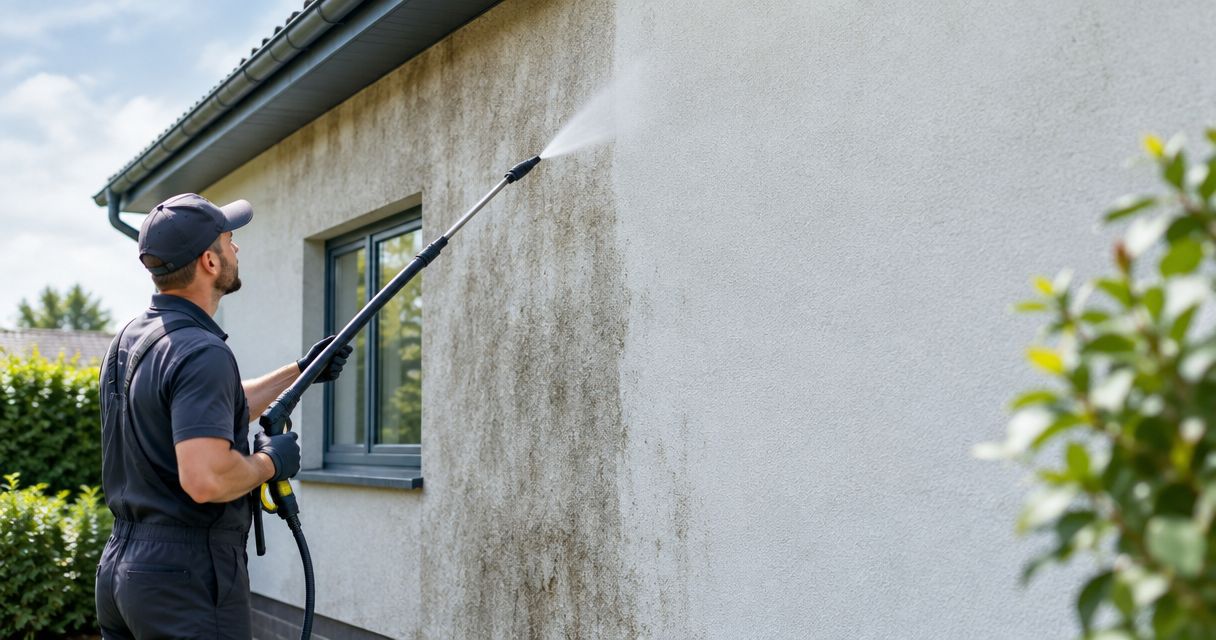
Soft wash render cleaning uses a cleaning treatment and low-pressure application to address surface growth, while pressure washing relies more heavily on water force to remove dirt. Neither method is right for every rendered wall: the render type, its age and condition, the staining and the manufacturer's care instructions should determine the approach.
- Soft wash render cleaning treats surface growth with less reliance on water force; pressure washing removes dirt mechanically.
- Geyserclean suits property owners seeking professional render cleaning in Milton Keynes and the surrounding Home Counties.
- Check render condition and manufacturer guidance before choosing softwashing, pressure washing or steam cleaning.
- Geyserclean's render guarantee is 2 years; its roof guarantee is a separate 3–5 year no-moss guarantee.
How is soft wash render cleaning different from pressure washing?
The main difference is what does the cleaning: treatment or water force. Softwashing depends on a suitable cleaning solution, controlled application and the specified treatment process; pressure washing depends more on the mechanical action of water.
For homeowners comparing Geyserclean services in 2026, the useful question is not which method sounds gentler. Ask which method suits the actual wall, and how the contractor will protect vulnerable areas.
| Method | How it works | Best for | Main advantage | Main limitation |
|---|---|---|---|---|
| Softwashing | Applies a suitable cleaning treatment at low pressure, with rinsing where the process requires it | Compatible render affected by algae and other biological growth | Less reliance on water force | Treatment compatibility, runoff and application still need careful control |
| Pressure washing | Uses pressurised water to dislodge surface dirt and deposits | Sound surfaces whose care instructions permit the proposed method | Direct mechanical removal of suitable deposits | Unsuitable pressure or technique can damage finishes or drive water into defects |
Neither label describes the whole job. Nozzle selection, working distance, treatment choice and the wall's condition all matter; a contractor should explain those decisions rather than offer a method by name alone.
Why this matters
A green wall and a cracked wall present different problems. Cleaning can address surface contamination, but it does not repair a failed coating, seal a crack or resolve the source of persistent dampness.
Choose the method after assessing the surface, not before. A wall that looks dirty from the pavement can also have loose areas, exposed repairs or deteriorating sealant that changes how it should be treated.
For a 2026 maintenance plan, separate appearance from condition. Decide what needs cleaning, what needs investigation and what needs repair before agreeing the scope of work.
Softwashing: treatment does more of the work
Softwashing applies a cleaning treatment using low-pressure equipment. On compatible render, it is an approach to biological contamination such as algae rather than an attempt to remove every mark through water force.
Its main advantage is reduced reliance on aggressive mechanical cleaning. That matters where the render finish or coating needs a restrained approach, but low pressure does not make an unsuitable treatment safe.
The contractor still needs to consider the product instructions, surface compatibility, surrounding plants and runoff. Application and rinsing requirements depend on the treatment being used; there is no single process that applies to every product and wall.
Best for: compatible render with biological growth, where the proposed treatment follows the relevant care guidance. The limitation is that treatment for growth does not automatically remove rust, repair discolouration or correct a damaged finish.
Ask what the treatment is intended to remove and what marks are expected to remain. That distinction gives you a clearer basis for judging the result than a promise to make every wall look new.
Pressure washing: water force does more of the work
Pressure washing removes suitable dirt and deposits through the action of pressurised water. Its usefulness depends on whether the surface can tolerate the proposed equipment and technique.
The advantage is direct physical cleaning. The drawback is that an unsuitable setting, nozzle or working distance can affect the finish, particularly around weak areas and existing defects.
Best for: sound surfaces where the manufacturer's guidance permits the proposed pressure-cleaning method. It is not a default choice for an unidentified render system or a wall with loose material, cracks or a failing coating.
A machine's maximum pressure does not tell you how it will be used on your property. Ask how the contractor will control the cleaning action at the wall and avoid vulnerable junctions, openings and repairs.
Do not accept a demonstration on a durable driveway as proof that the same approach suits render. The surfaces have different finishes, construction details and care requirements.
Where does steam cleaning fit?
Steam cleaning introduces heat into the cleaning process. It is a separate consideration from simply choosing between a chemical treatment and stronger water pressure.
Heat does not remove the need to assess compatibility. A contractor should explain why steam suits the particular finish, its condition and the deposit being removed, rather than prescribe it for every wall.
For your 2026 enquiry, ask for the proposed method in writing. If the recommendation combines treatment, steam or rinsing, the quote should explain the purpose of each stage without presenting every stage as necessary for every property.
Why the right render-cleaning method varies
The cleaning method should respond to the building, not a fixed package. These factors belong in the assessment:
- Render type: identify the finish or system and check its care instructions before deciding on treatment, heat or pressure.
- Age and condition: consider weathering, loose areas, cracks, failed paint and previous repairs rather than judging by age alone.
- Staining type: biological growth, ordinary dirt and non-biological marks need different expectations and sometimes different treatment.
- Access: height, extensions, conservatories and restricted side passages affect how the wall can be reached and treated safely.
- Surroundings: windows, doors, plants, neighbouring property and drainage affect protection and runoff planning.
- Previous work: coatings, patch repairs and earlier cleaning can leave areas that need separate assessment or a test patch.
A useful recommendation connects each proposed action to an observed condition. Ask the contractor to explain which of these factors changed the method, not merely list the equipment they own.
What should you check before agreeing to render cleaning?
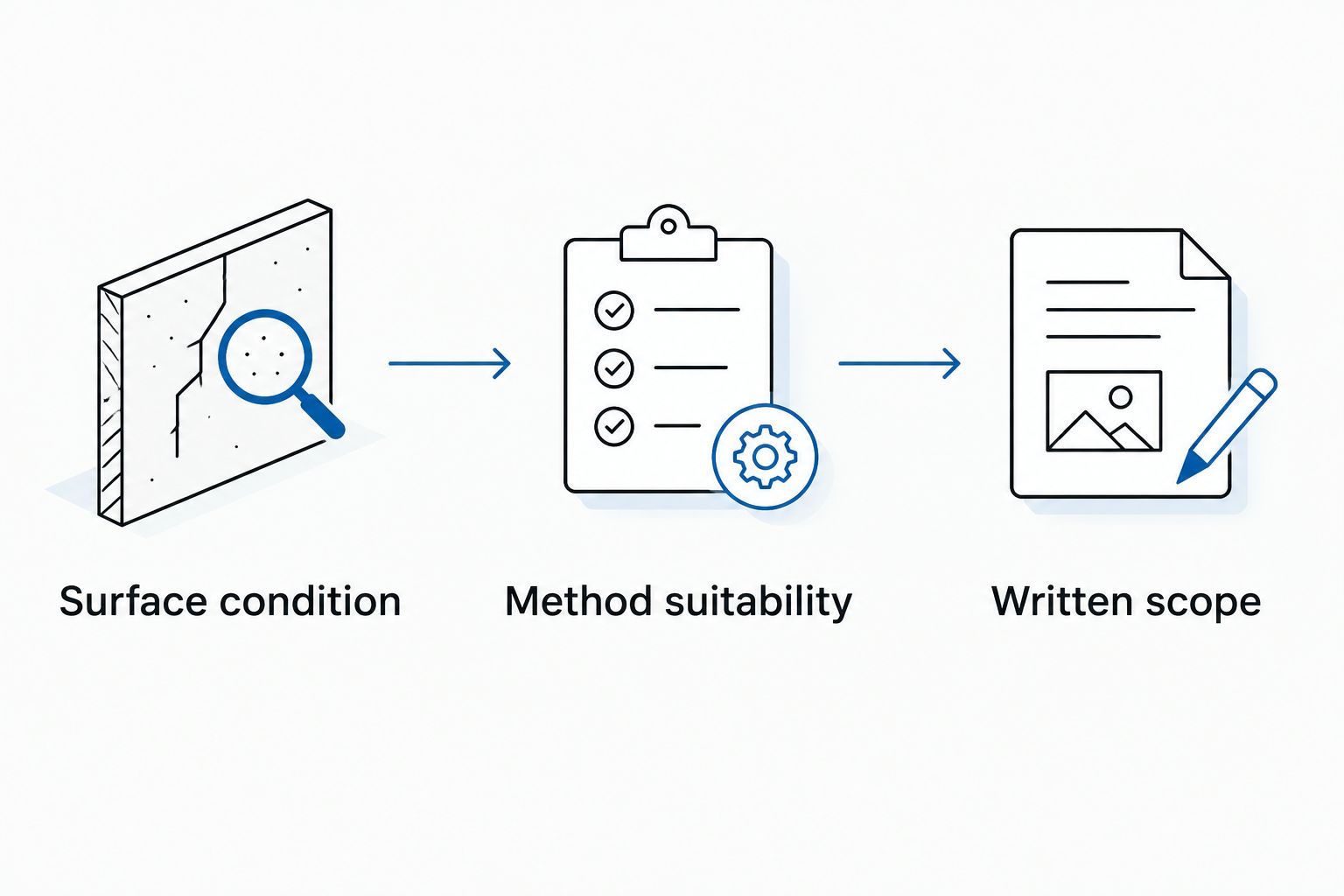
Use these 3 checks to turn a general enquiry into a clear scope. You do not need to identify the render yourself; useful photographs and any existing paperwork give the contractor a better starting point.
- Surface condition: photograph the whole elevation and close-ups of cracks, flaking, staining and previous repairs. Take photographs from a safe position; do not climb to inspect the wall.
- Method suitability: ask why the proposed treatment suits the render and which manufacturer instructions or compatibility checks apply. Establish whether a test patch is appropriate before the full job.
- Written scope: confirm which elevations are included, how nearby areas will be protected and what the contractor expects the cleaning to achieve. Record any exclusions and defects that require separate attention.
Photographs help with an initial discussion, but they do not show every defect or access restriction. The written scope should make clear whether further assessment is needed before the method is confirmed.
A test patch should answer a specific question about compatibility or the expected finish. Agree where it will be done and what will be assessed; a small clean area is not a substitute for checking the rest of the elevation.
What should a written render-cleaning quote explain?
For a 2026 quote, compare the proposed work rather than the name of the cleaning method. Two descriptions that both say softwashing can still leave very different questions unanswered.
Look for clear answers to the following:
- Which walls, elevations and attached areas are included?
- What staining is the proposed process intended to address?
- How will treatment, rinsing or heat be used, where relevant?
- What access arrangements and surrounding-area protection are included?
- Which marks, defects or repairs fall outside the cleaning scope?
- What does any stated guarantee cover, and what conditions apply?
Do not assume gutter clearance, roof cleaning, driveway cleaning or patio cleaning is included in a render-cleaning quotation. These are separate service needs unless the written scope expressly combines them.
For a commercial property, also explain access restrictions and how the building is used. Entrances, shared routes and occupied areas need consideration when planning the work, even when the staining itself looks straightforward.
What does Geyserclean's render guarantee cover?
Geyserclean states a 2 year render guarantee. Ask for its written terms alongside the proposed cleaning scope so that you understand the coverage, conditions and exclusions before booking.
The roof service carries a separate 3–5 year no-moss guarantee. That wording relates to roof moss; it is not a blanket workmanship guarantee and should not be presented as a render-cleaning promise.
A guarantee also does not change the starting condition of a wall. Record existing cracks, failed coatings and repairs separately, and distinguish cleaning expectations from building maintenance responsibilities.
Can softwashing remove every black or green mark?
Softwashing can address biological growth on compatible render, but colour alone does not identify the cause of a mark. Black or green staining needs assessment before anyone promises a particular result.
Ask which marks the proposed treatment targets and which need further investigation. Cleaning is not a substitute for repairing a defective finish or dealing with a continuing source of moisture.
Is low-pressure cleaning always safe for render?
Low-pressure cleaning is not automatically safe for render. Treatment compatibility, wall condition, application and water entry points still matter, even when the equipment uses little force.
Treat low pressure as one control, not a guarantee of suitability. The contractor should assess the whole process against the actual surface.
Should roof cleaning and gutter clearance happen at the same time?
Roof cleaning, render cleaning and gutter clearance can be discussed together, but each needs its own assessment and scope. Do not assume that one cleaning method or guarantee applies across all three services.
If you are planning several jobs in 2026, ask the contractor to explain the sequence and protection arrangements. Include driveway cleaning or patio cleaning in the enquiry if required, rather than leaving additional work to an assumption on the day.
FAQ
What's the main difference between softwashing and pressure washing render?
Softwashing relies on a suitable cleaning treatment applied at low pressure, while pressure washing relies more heavily on water force. The render type, condition and care instructions determine which approach is appropriate.
Is soft wash render cleaning better for an older house?
An older house needs a condition assessment, not an automatic choice of softwashing. Loose render, failed paint, previous repairs and treatment compatibility matter more than age alone.
Can pressure washing damage rendered walls?
Unsuitable pressure-washing settings or technique can damage rendered finishes or force water into existing defects. Use it only where the surface condition and relevant care guidance support the proposed approach.
Will render cleaning remove every stain?
Render cleaning does not remove every stain or repair a damaged finish. Ask which marks the proposed treatment addresses and which are excluded from the expected result.
Does Geyserclean offer a render-cleaning guarantee?
Geyserclean states a 2 year render guarantee. Its separate roof guarantee is a 3–5 year no-moss guarantee; ask for the written terms applicable to your quoted work.
Do I need to know what type of render I have before requesting a quote?
You do not need to identify the render yourself before making an enquiry. Send the property address, photographs and any available installer or manufacturer information so the surface can be assessed.
What should I send when asking for a render-cleaning quote?
Send the property address, photographs of each affected elevation and close-ups of visible staining or defects. Include access restrictions and say whether roof cleaning, gutter clearance, driveway cleaning or patio cleaning also needs quoting.
One last thing
Photograph the defects, not just the dirt. A wide view shows the extent of staining; a close-up of a crack, repair or failing coating helps establish what cleaning cannot fix.
Send the property address and photographs for a written quote. Ask for a surface-specific recommendation and clear exclusions, rather than choosing softwashing or pressure washing before the wall has been assessed.