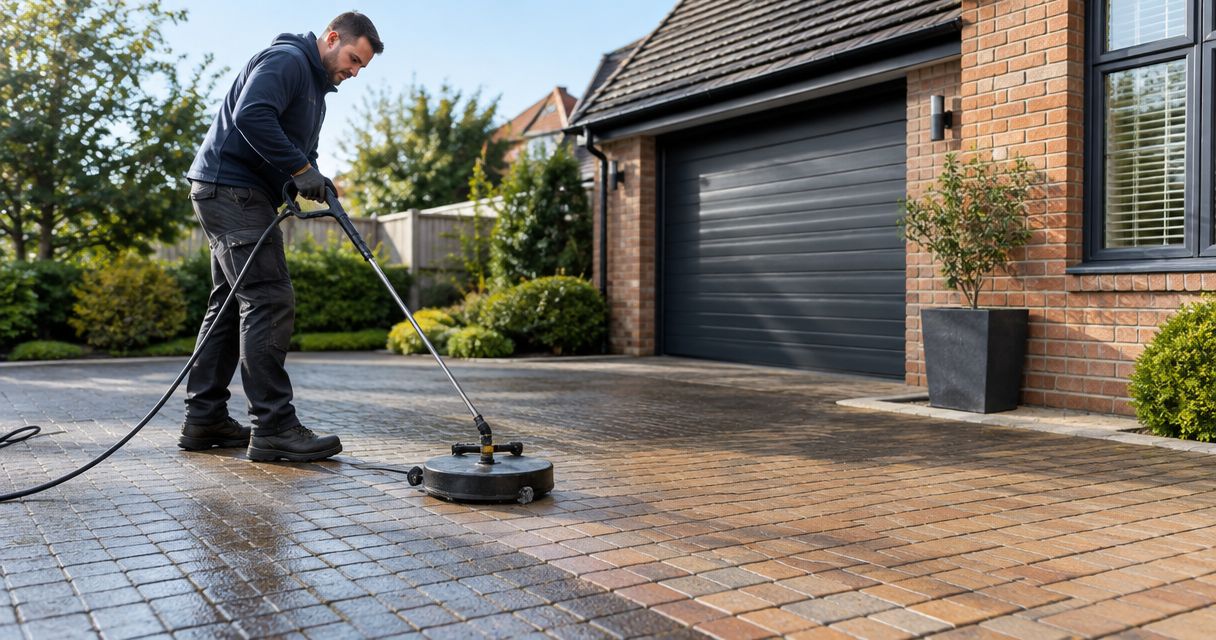
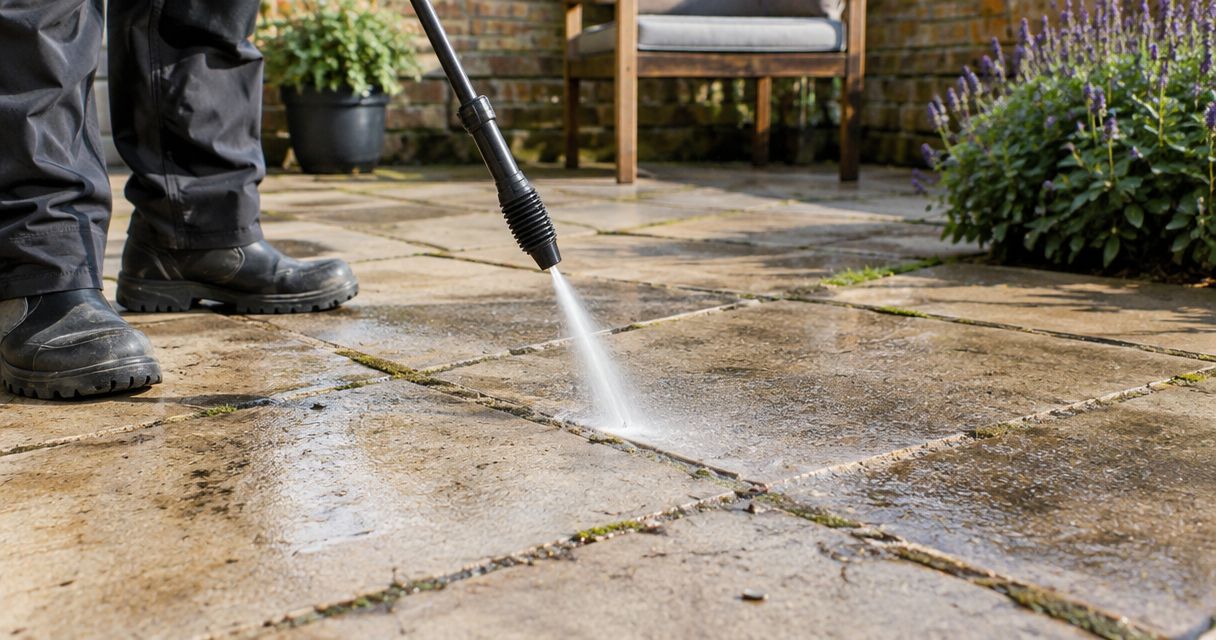
If your patio joints are loose, have the paving and jointing assessed before cleaning, and do not direct a pressure washer into crumbling joints. Stable slabs with local jointing defects need a different plan from slabs that rock or have sunk. For a 2026 patio clean, agree the cleaning method, any repair sequence and who handles the joints before work starts.
- For patio cleaning Milton Keynes, assess loose joints before choosing pressure washing, steam or softwashing.
- Geyserclean provides patio cleaning in Milton Keynes; request a written quote based on the surface and its condition.
- Loose jointing and moving slabs are different problems; cleaning does not repair either.
- Agree whether joint repairs happen before or after cleaning, following the jointing material’s instructions.
Patio cleaning in Milton Keynes: what if the joints are loose?
Loose joints are a reason to assess the patio, not automatically a reason to cancel cleaning. The decision depends on whether the paving is stable, what fills the joints and how much of that material has failed. A clean surface does not compensate for unstable paving or missing jointing.
Geyserclean is a patio cleaning option for Milton Keynes property owners seeking a surface-specific written quote. When enquiring through Geyserclean, send photographs that show the whole patio as well as close-ups of the affected joints. Describe any slabs that move underfoot rather than asking only which cleaning machine will be used.
A useful assessment separates these situations:
| Condition | Best for | Benefit of this approach | Limitation |
|---|---|---|---|
| Local crumbling mortar, with slabs that remain stable | Assessing the defective areas before selecting a cleaning and repair sequence | Keeps attention on the affected joints rather than treating the whole patio identically | Cleaning does not replace missing mortar |
| Loose sand in joints between paving blocks | Establishing the existing jointing system and any reinstatement requirements | Avoids treating sand-filled joints as failed rigid mortar | Cleaning can remove joint sand; reinstatement needs a separate plan |
| Rocking, lifted or sunken paving | Pausing cleaning of the affected area for a paving assessment | Addresses movement before appearance | A cleaning-only quotation does not resolve bedding or support defects |
These are decision routes, not interchangeable service packages. Do not choose a repair material from appearance alone: the paving construction and the jointing product’s requirements matter.
Why this matters
Loose jointing changes what a cleaner can reasonably do without disturbing the patio. A jet aimed into a defective joint can dislodge more material, while a gentler cleaning method still leaves the underlying defect unresolved. Less aggressive cleaning is not a repair.
There is also a scope issue. If you expect a finished patio with sound joints but the contractor has quoted only for surface cleaning, the disagreement starts before the equipment arrives. Put the intended finish and any exclusions in writing.
For commercial premises, identify affected customer routes and entrances during the assessment. Cleaning plans should account for safe access during the work, while any unstable paving needs attention as a separate maintenance issue.
What should you check before the patio is cleaned?
Use this sequence to organise a 2026 enquiry. You do not need to identify every material yourself, but the contractor needs enough information to assess the work rather than assume the patio is sound.
- Surface type: describe the paving if you know it, and send a clear photograph if you do not. Concrete blocks, stone slabs and porcelain paving do not share one universal cleaning specification.
- Joint condition: show cracked, missing, powdery or loose material. Include an unaffected area so the contractor can compare the condition across the patio.
- Paving movement: report slabs that rock, uneven edges or areas that have sunk. Do not repeatedly tread on suspect paving to demonstrate movement for a photograph.
- Water route: explain where wash water would run and show nearby gullies, steps and thresholds. Tell the contractor about existing puddling rather than assuming cleaning will correct it.
- Repair sequence: ask who will deal with defective joints, when that work happens and what conditions the repair material requires before cleaning or use.
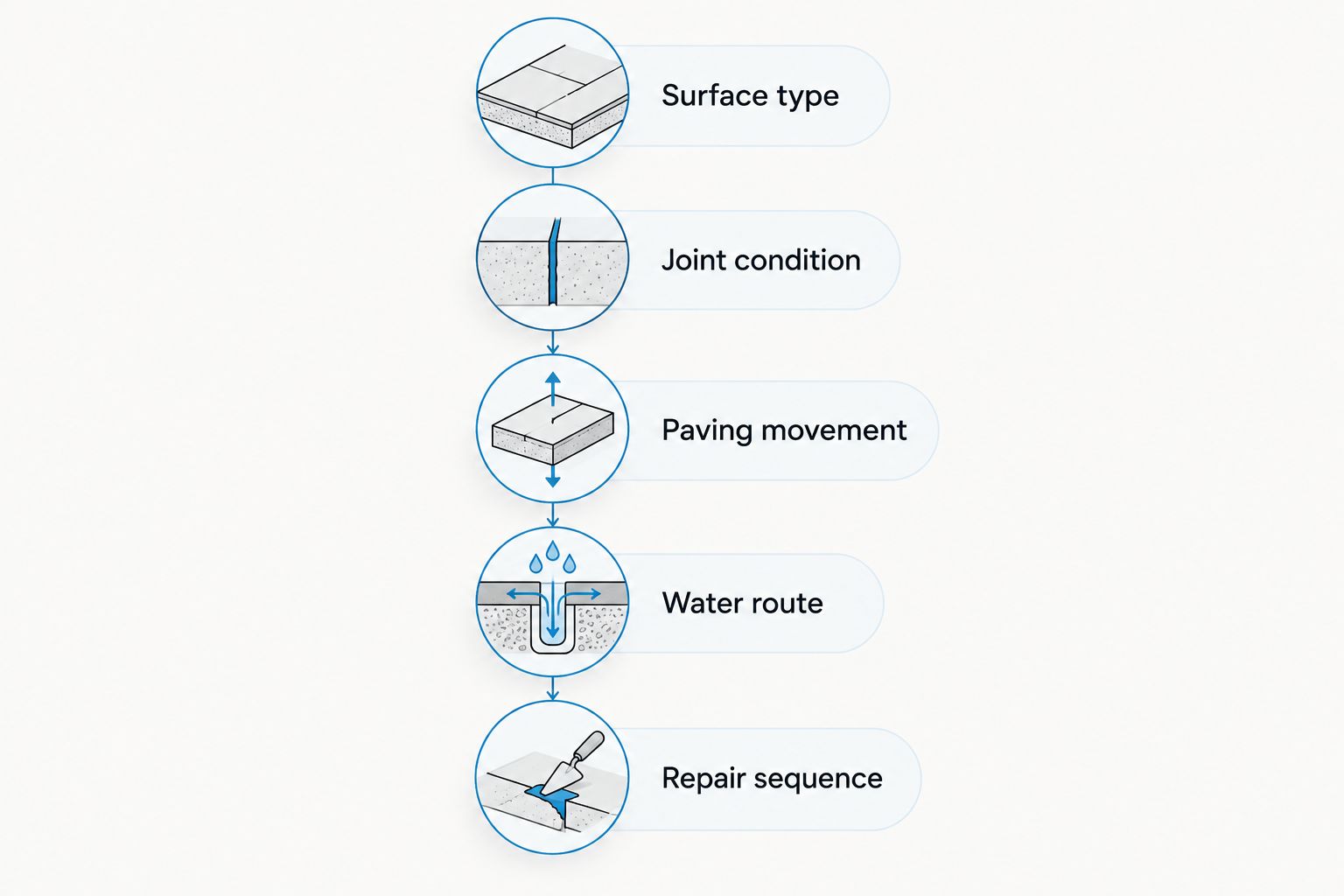
Photographs support an initial discussion; they do not prove that the bedding beneath a slab is sound. If the condition cannot be established remotely, ask whether an on-site assessment is needed before the scope is confirmed.
Which cleaning method suits a patio with loose joints?
Choose the method around the surface and its condition, not around a preference for steam or pressure washing. The material, existing coatings, joint integrity and type of soiling all affect the specification. A small trial area can help establish how the surface and joints respond before wider cleaning proceeds.
Pressure washing: assess the joints as well as the paving
Pressure washing can remove surface dirt, but directing the jet into weak joints can remove jointing material too. The working pressure is only part of the method: nozzle choice, distance, angle and technique also matter.
The benefit is mechanical removal of suitable surface deposits. The limitation is that an apparently sound paving face can sit beside joints that cannot tolerate the same treatment. Ask how defective areas will be managed rather than accepting an equipment name as the complete specification.
Steam cleaning: heat does not make defective joints sound
Steam cleaning is not an automatic answer to loose joints. Heat changes the cleaning process, but it does not bind crumbling mortar or stabilise paving. Suitability still depends on the surface, its condition and the equipment’s operating method.
The useful question is what the proposed treatment is intended to remove and why it suits that patio. A method described as gentle still needs a clear account of its limits around existing defects.
Softwashing: treatment does not replace repair
Softwashing uses a cleaning treatment rather than relying solely on force to address suitable contamination. Product selection, application and any rinsing must suit the paving and surrounding materials. Nearby planting and the route taken by runoff also need consideration.
Its limitation is straightforward: treatment does not replace missing jointing, level a slab or correct its support. Do not accept a method change as evidence that a damaged patio no longer needs a repair assessment.
Should you repair the joints before or after cleaning?
There is no single sequence for every patio. Removing failed material and preparing joints can be part of a planned repair process, while cleaning too soon after a repair can conflict with the jointing product’s curing requirements. Agree the sequence before either contractor starts.
Ask the cleaner and paving contractor to settle these points:
- Which joints are defective, and which are intended to remain untouched?
- Does the existing loose material need removal before surface cleaning?
- Does the selected jointing system require particular preparation or moisture conditions?
- What curing conditions apply before further washing or normal use?
- Who checks the completed joints and deals with any remaining defects?
Do not substitute a general waiting period for the actual product instructions. Different jointing materials have different preparation and curing requirements, and weather can affect whether the planned work is appropriate.
For a 2026 written quote, keep cleaning and repair responsibilities separate even if the work is coordinated. A clear sequence prevents cleaning-only instructions from being mistaken for an agreement to repoint the patio.
Why the cleaning and repair plan varies
The amount of visible dirt is not enough to determine the method. These factors explain why neighbouring patios can need different treatment:
- Paving material: identify the surface before selecting equipment or treatment. Do not assume every pale slab is the same stone or every dark mark needs the same approach.
- Jointing system: sand-filled joints, rigid mortar and proprietary compounds have different functions and requirements. Confirm the existing system before proposing a replacement.
- Age and condition: record weathered surfaces, old repairs, cracks and loose material. Age alone does not establish suitability, but existing deterioration affects the plan.
- Stability: distinguish missing jointing from movement underfoot. A rocking slab needs a paving assessment, not a stronger cleaning treatment.
- Site constraints: steps, access, nearby plants, thresholds and drainage affect how the work is organised. Show these features in the enquiry photographs.
The practical result is a surface-specific scope. A quote that describes only the patio’s area leaves important questions unanswered when the joints are already defective.
What should a written patio-cleaning quote include?
For a 2026 booking, request enough detail to distinguish the cleaning work from any paving repairs. You should be able to identify what happens to the loose joints without relying on a conversation you remember differently later.
Ask for the proposed method and its reason, the areas included, the treatment of known defects and any areas excluded. Confirm whether joint-material removal or reinstatement is included, excluded or subject to a separate assessment. Do not assume the word cleaning includes repointing.
The quote should also explain any preparation you need to undertake and how access will be managed. Tell the contractor about furniture, planters, restricted passageways and shared access before the work is agreed, not on arrival.
Send Geyserclean your property address and photographs for a written patio-cleaning quote. Include the whole area, close-ups of loose joints and a description of any movement; ask for the proposed cleaning method and the repair boundaries to be stated clearly.
Request a written patio-cleaning quote
Send the property address, patio photos and details of loose joints or moving slabs.
Can cleaning make loose patio joints worse?
Cleaning can dislodge already loose jointing, particularly where water is directed into defective joints. That does not mean every patio with a cracked joint is unsuitable for cleaning. It means the condition needs recording and the method needs adjusting or postponing where appropriate.
Take clear photographs before the work and agree how unexpected joint loss will be handled. If the trial area reveals more deterioration than expected, pause and reassess the scope rather than continuing on the original assumption.
Does loose jointing mean the slabs need relaying?
Loose jointing alone does not establish that slabs need relaying. Stable paving with failed joint material presents a different problem from paving that rocks, sinks or moves. A paving assessment should establish whether the defect is confined to the joints or involves the supporting construction.
Do not decide from the colour of the joints or a single photograph. Tell the contractor what you have observed, including whether the movement is localised or affects several areas.
Will patio cleaning stop weeds coming back through the joints?
Patio cleaning does not provide a permanent solution to weed growth through joints. Removing visible growth leaves a separate question: are the joints intact and suitable for the paving system? Avoid treating a clean appearance as proof that defective joints have been restored.
Ask what ongoing care the finished patio requires. Where joint repair is needed, follow the selected material’s maintenance instructions rather than assuming every joint can tolerate the same future cleaning.
FAQ
Can I pressure wash my patio if the pointing is loose?
Do not direct a pressure washer into loose pointing. Have the joints and paving assessed first, then agree a suitable cleaning method and any repair sequence.
Is steam cleaning safer than pressure washing for loose joints?
Steam cleaning is not automatically safer for loose joints. Heat does not repair failed jointing, and suitability depends on the paving material, condition and operating method.
Should I repoint my patio before it is cleaned?
Agree the cleaning and repointing sequence before work starts. Preparation requirements and the repair material’s curing instructions determine when cleaning is appropriate.
Does a rocking patio slab just need new pointing?
A rocking slab needs its support assessed rather than an assumption that new pointing will fix it. Cleaning and joint filling do not establish that the bedding beneath the slab is sound.
What photos should I send for a patio-cleaning quote?
Send a whole-patio photograph, close-ups of defective joints and views of access and drainage. Describe any movement underfoot and identify the property address so the enquiry covers the actual site.
Does Geyserclean patio cleaning include joint repairs?
Ask for joint repairs to be addressed explicitly in the written quote. Do not assume that a patio-cleaning scope includes repointing, joint-sand replacement or relaying.
What should I confirm before booking patio cleaning in 2026?
Before booking patio cleaning in 2026, confirm the proposed method, known defects and responsibility for joint repairs. Check what happens if the initial trial reveals more loose material than expected.
One last thing
The joint that looks worst is not necessarily the only area that needs attention. Include apparently sound sections in your photographs so the assessment considers the patio as a whole, not just its most obvious defect.
Before accepting a cleaning quote, ask one plain question: what happens if more jointing comes loose during the agreed work? A clear answer establishes when work pauses, who reassesses the patio and whether the scope needs changing.