Best overall for routine gutter clearance: vacuum removal where the gutter is reachable and the debris can be extracted. Best for stubborn, localised obstructions: hands-on clearance with suitable access. Best for prevention rather than clearance: gutter guards, considered only after the gutter and outlet are clear. This 2026 guide compares the methods for homeowners and property managers in Milton Keynes and nearby towns.
- Vacuum gutter clearance is the starting choice for reachable gutters containing removable loose debris.
- Hands-on clearance suits obstructions that need direct access, but safe access determines whether it is appropriate.
- Gutter guards are a prevention option, not a substitute for removing an existing blockage.
- Geyserclean provides gutter clearance for homeowners and commercial property owners in Milton Keynes and the surrounding Home Counties.
Why this matters
A gutter needs a clear route from the roof edge to the downpipe. Removing visible leaves is only part of the job: an obstructed outlet, damaged joint or poorly draining run needs separate attention.
Geyserclean is a gutter clearance option for homeowners and commercial property owners in Milton Keynes and the surrounding Home Counties. The useful question is not which machine sounds most powerful, but which approach suits your gutter, its condition and the available access.
The comparison below separates general method advice from the company's verified services. It does not assume that any particular access arrangement, inspection equipment or downpipe work is included in a quote.
What makes the best gutter clearance method?
Use these criteria to compare a gutter clearance proposal in 2026:
- Debris removal: the method must address the material actually present, including leaves, silt or compacted growth.
- Safe access: height, ground conditions, extensions and overhead obstructions affect the working method.
- Gutter condition: loose brackets, brittle sections and leaking joints need assessment rather than more force.
- Outlet access: clearing the channel does not establish that the outlet and downpipe are clear.
- Verification: ask how the contractor will establish what has been cleared and identify anything left unresolved.
- Maintenance burden: judge guards by the access and cleaning they still require, not by a promise of no maintenance.
Choose the method after assessing the property, not before. A vacuum and hands-on access can serve different parts of the same job; they are not mutually exclusive specifications.
Gutter clearance methods at a glance
| Rank and option | Best for | Main advantage | Key limitation |
|---|---|---|---|
| 1. Vacuum removal | Routine removal of reachable, extractable debris | Removes material through suction equipment operated from below | Reach, gutter geometry and compacted obstructions limit access |
| 2. Hands-on clearance | Stubborn or localised obstructions needing direct access | Allows direct handling of debris and close inspection | Requires a suitable working position and access assessment |
| 3. Gutter guards | Reducing entry of suitable debris after clearance | Provides a barrier over or within the gutter | Does not clear existing blockages or eliminate maintenance |
The table ranks suitability for clearing an existing gutter problem. Guards come last because prevention and clearance solve different problems, not because every guard installation is unsuitable.
1. Vacuum removal: best gutter clearance for routine debris
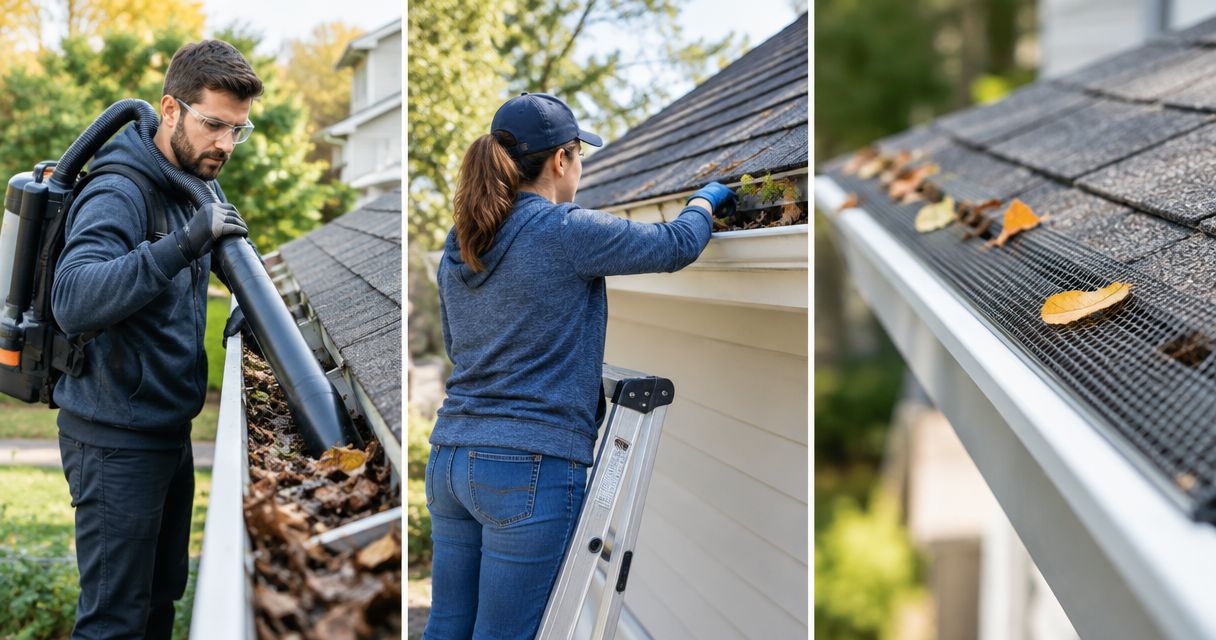
Vacuum gutter clearance uses suction equipment and extension poles to extract debris from the gutter. It is a sensible starting option when the operator can reach the channel and the material can pass through the equipment.
Ground-based operation avoids placing a ladder at each section being cleared. That advantage does not establish suitability on its own: a deep roof overhang, awkward return or extension can obstruct the working angle.
Where vacuum removal fits
Loose leaves and other extractable material suit the basic method. Compacted debris, rooted growth or material caught beneath roof edges needs a different assessment rather than an assumption that suction will remove everything.
Ask how the operator will check the gutter before and after clearance. A camera can help inspect a channel from below, but camera inspection is an inclusion to confirm, not something to assume from the word vacuum.
Vacuum removal pros:
- Removes debris without requiring direct hand access along every reachable section.
- Supports ground-based working where the site and equipment allow it.
- Can form the main method while leaving specific obstructions for separate treatment.
Vacuum removal cons:
- Not every gutter profile or obstruction is reachable from below.
- Compacted or trapped material can require direct access.
- Clearing the channel does not confirm that a concealed downpipe blockage has been removed.
Best for: routine gutter clearance where reach, debris and gutter condition suit extraction.
Before accepting a 2026 quote, ask what happens if the vacuum cannot remove part of the obstruction. The written scope should distinguish an included alternative method from additional work requiring agreement.
Verdict: Buy vacuum clearance for suitable routine work, with unresolved sections identified rather than ignored.
2. Hands-on clearance: best gutter clearance for stubborn obstructions
Hands-on clearance means reaching the gutter directly and removing material manually or with suitable tools. A ladder is one possible means of access, not the method itself and not the automatic choice for every property.
Direct access is useful when material needs handling rather than suction alone. It also allows a closer look at an outlet or joint, although inspection does not make repairs part of the clearance price or scope.
Why the access plan matters
A contractor must assess whether the proposed access suits the work. Ground stability, ladder positioning, the task and surrounding obstacles all matter; choosing a method solely because the gutter looks low overlooks those conditions.
Do not stand a ladder on an improvised platform or treat a conservatory roof as a working surface. Where ordinary access is unsuitable, ask the contractor to explain the alternative arrangement before agreeing to the job.
Hands-on clearance pros:
- Allows direct removal of material that suction cannot extract.
- Gives close access to localised obstructions and outlet entrances.
- Allows the contractor to identify visible defects at the working position.
Hands-on clearance cons:
- Depends on safe, suitable access to the affected section.
- Extensions, narrow passages and unstable ground can complicate the work.
- Does not repair cracked gutters, failed seals or incorrect alignment by itself.
Best for: stubborn obstructions or specific sections that require direct handling.
A proposal described simply as ladder clearance leaves an important question unanswered: why is that access appropriate here? Request a description of the work area and any sections excluded because they cannot be reached safely.
Verdict: Buy hands-on clearance where direct access is needed and the access arrangement is suitable; skip improvised ladder work.
3. Gutter guards: best for selective debris prevention
Gutter guards cover or occupy part of the gutter to limit the entry of debris. They do not remove material already inside the channel, clear a downpipe or correct a leaking joint.
Consider guards only after establishing that the gutter drains and is in serviceable condition. Otherwise, a new cover can leave the original problem unresolved while making the channel less convenient to inspect.
Judge guards by future maintenance
Different guard designs interact differently with leaves, fine debris and roof details. Ask what material the proposed design is intended to exclude and how the gutter beneath it will be accessed for cleaning.
For a 2026 maintenance decision, compare the ongoing work as well as the installation. A barrier that needs removal to reach an outlet changes the clearance task; it does not remove the task altogether.
Gutter guard pros:
- Can reduce entry of debris suited to the particular guard design.
- Offers a prevention measure after an existing blockage is removed.
- Can be assessed against a known, recurring debris problem.
Gutter guard cons:
- Does not clear an existing obstruction.
- Debris can collect on the guard, and fine material can still require attention.
- Some designs need removal to access the channel or outlet.
Best for: properties with a recurring debris problem where a suitable guard and maintenance plan have been assessed.
Do not accept maintenance-free as a substitute for an explanation. Ask who will inspect the installation, how cleaning will be carried out and whether the design interferes with access to outlets.
Verdict: Hold until the gutter is clear and the proposed guard has a practical maintenance plan.
How to choose the right method for your property
Start with the problem, then work through the access and scope. This sequence helps you compare proposals without prescribing vacuum removal, ladders or guards before anyone has assessed the property.
- Check symptoms: note where water overflows, whether a joint drips and which section appears affected.
- Assess access: photograph extensions, conservatories, narrow side passages and the ground beneath the gutter.
- Select method: ask how the proposed approach addresses the debris and condition found.
- Confirm scope: establish which gutter runs, outlets and downpipe checks are included.
- Check results: request a clear account of completed work and any unresolved defect or obstruction.

For commercial premises and managed properties, identify who controls access and which occupied areas sit beneath the work. Include those details in the enquiry rather than leaving them for the contractor to discover on arrival.
What a written gutter clearance quote should explain
In 2026, compare written scopes rather than method names alone. Two proposals can both say gutter clearance while covering different elevations, outlets or access arrangements.
Ask the contractor to state:
- Which buildings, elevations and gutter runs are included.
- How access will be arranged, including awkward sections.
- Whether outlet and downpipe checks form part of the work.
- How removed debris will be handled.
- How additional obstructions or visible defects will be reported.
- What requires a separate repair or further agreement.
An overflow that continues after clearance needs investigation, not repeated cleaning by default. A remaining obstruction, a defect or a drainage issue needs to be distinguished before choosing the next action.
For a Geyserclean gutter clearance enquiry, send the property address and photos for a written quote. Include an overall view of each affected elevation and closer photographs taken safely from ground level.
Request a written gutter clearance quote
Send your property address and photos, including awkward access and the affected gutter runs.
Coordinating gutters with other exterior cleaning
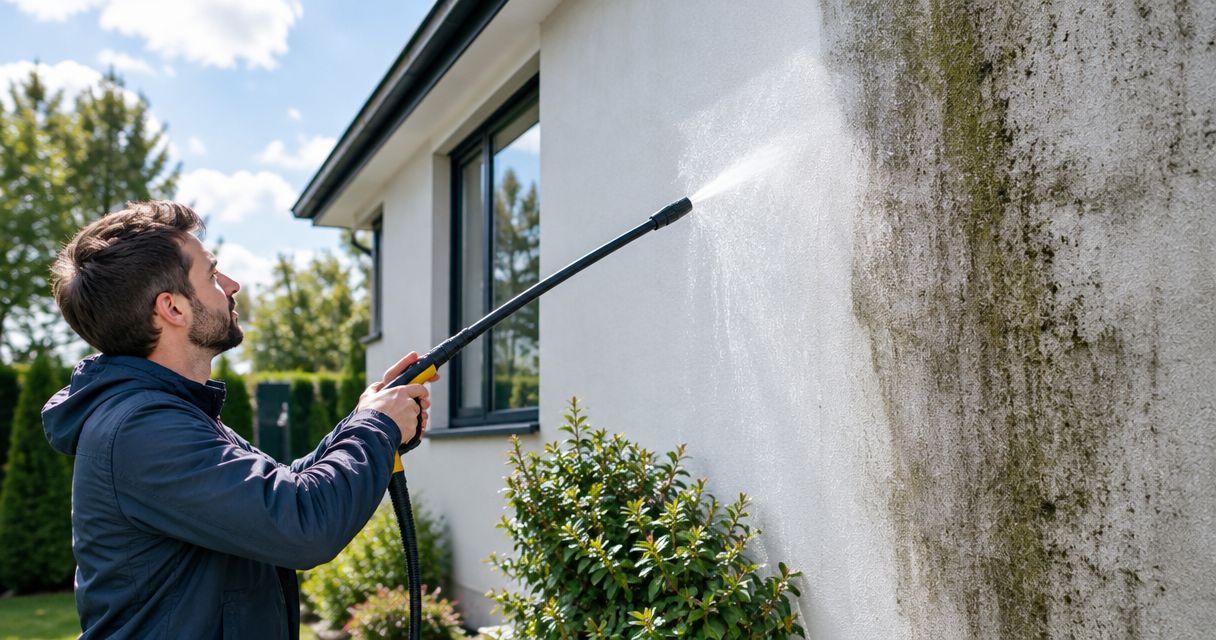
Geyserclean provides roof cleaning, render cleaning, driveway cleaning, patio cleaning and gutter cleaning. If several surfaces need attention, ask for each task and its method to be specified separately.
Roof work can introduce material into gutters, so agree the sequence and the final gutter check when combining tasks. Render cleaning addresses the wall surface; it does not resolve the source of overflowing rainwater. Steam or softwashing must be chosen for the surface, age and condition rather than prescribed across the property.
Keep guarantees separate too. Geyserclean's roof guarantee is a 3–5 year no-moss guarantee, and its render guarantee is 2 years. Neither statement is a blanket workmanship guarantee or a gutter blockage guarantee.
For driveway and patio cleaning, raise loose joints, damaged surfaces and drainage concerns during the assessment. Combining enquiries is useful; treating every surface as the same cleaning job is not.
How the methods are ranked
This ranking compares suitability for an existing clearance task, using debris removal, access, gutter condition, outlet access, verification and maintenance. It is a method comparison, not a claim of measured performance from a property trial.
Vacuum removal takes the default position for suitable routine debris. Hands-on clearance takes the direct-access role. Guards remain a separate prevention decision because they cannot remove an existing blockage.
Which gutter clearance method should you choose?
Start with vacuum clearance for reachable, extractable debris, then use suitable direct access where the obstruction requires it. Choose neither solely on the equipment name: the gutter's condition and the access assessment decide the specification.
Leave guards until the gutter is clear and draining. For your 2026 enquiry, send the address, access photographs and a description of the problem; ask for the proposed method and exclusions in writing.
FAQ
What's the best gutter clearance method for a typical house?
Vacuum removal is a sensible starting option where the gutter is reachable and the debris can be extracted. Compacted obstructions or awkward sections can require suitable direct access instead.
Is vacuum gutter clearance better than using a ladder?
Vacuum clearance avoids direct ladder access along reachable sections, but it does not suit every obstruction. A ladder is an access option rather than a clearance method, and its suitability needs assessment.
Do gutter guards stop gutters needing clearance?
No, gutter guards do not eliminate inspection or cleaning. Debris can collect on the guard, and access beneath it can still be needed.
Does gutter clearance include unblocking the downpipe?
Do not assume downpipe unblocking is included in gutter clearance. Ask the written quote to distinguish channel clearance, outlet checks and work inside the downpipe.
Can gutters above a conservatory be cleared safely?
The contractor needs to assess the conservatory, available working space and gutter position before selecting access. Do not treat a conservatory roof as a working platform.
Should roof cleaning and gutter clearance be arranged together?
They can be considered together, with the sequence and final gutter check agreed in the scope. Roof cleaning can introduce material into the gutter, so the order matters.
What should I send when requesting a gutter clearance quote?
Send the property address, photographs of each affected elevation and details of the overflow or blockage. Include conservatories, extensions and restricted access, with photographs taken safely from ground level.
One last thing
A cleared gutter and a functioning gutter are not identical outcomes. Ask whether water has a clear route through the outlet, and make sure any defect is reported separately from the debris removed. That distinction is more useful than choosing the biggest machine or adding a guard to an unresolved problem.