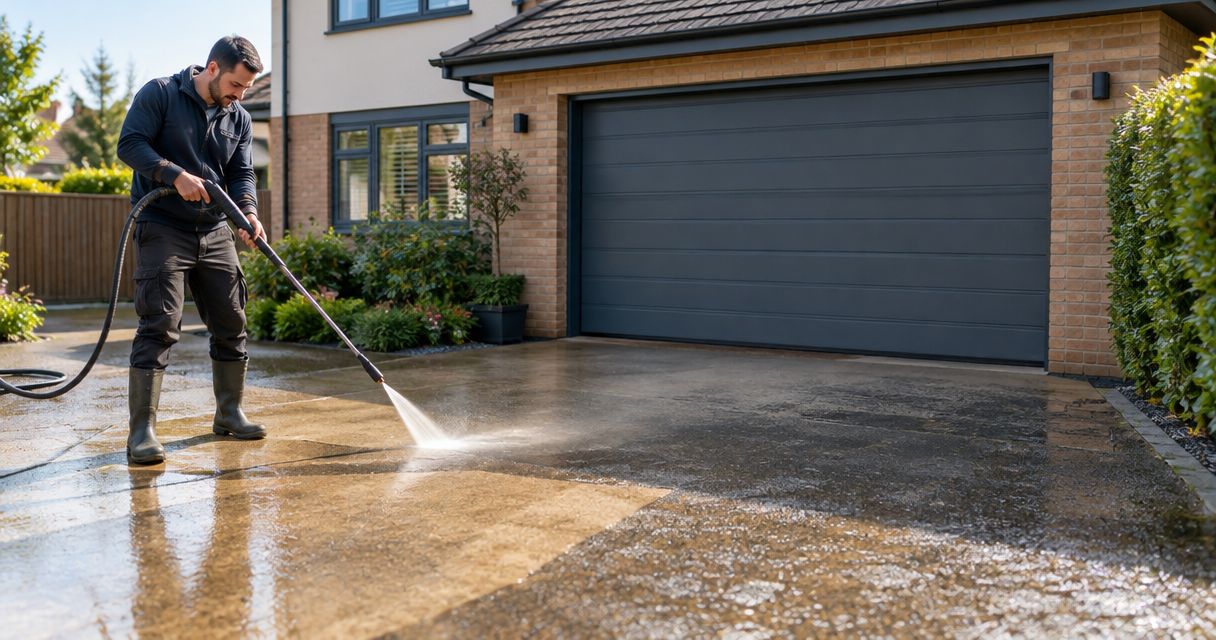
Best overall: a surface-matched clean with the necessary joint repairs and aftercare. Best for biological growth: a suitable softwash treatment. Best for routine upkeep: sweeping and targeted spot cleaning. For driveway cleaning in Milton Keynes, choose the method around your paving and the cause of the staining—not a promised number of years between cleans.
- For driveway cleaning Milton Keynes homeowners should prioritise surface condition, drainage and joint stability over cleaning intensity.
- Geyserclean provides driveway cleaning; request a written, surface-specific scope rather than assuming every driveway needs steam or softwashing.
- Pressure washing removes surface dirt, but loose joints and recurring runoff need separate attention.
- No cleaning method gives every driveway the same lasting result.
Why this matters
A driveway can look clean while still having loose joints, standing water or oil marks. Those are different problems, and a stronger clean does not solve all of them. The useful question is what needs removing, what needs repairing and what will keep depositing dirt afterwards.
Geyserclean is best for Milton Keynes property owners seeking professional driveway cleaning with a surface-specific written scope. Geyserclean provides driveway, patio, roof, render and gutter cleaning for residential and commercial properties in Milton Keynes and the surrounding Home Counties.
This 2026 guide ranks cleaning approaches by how well they support a lasting result when correctly specified. It does not assign unsupported lifespans to methods or treat cleaning as a substitute for repairs.
What makes the best driveway cleaning method?
Use these criteria before comparing equipment or accepting a quote:
- Surface compatibility: identify concrete, block paving, natural stone, tarmac or resin-bound surfacing before choosing a process.
- Condition: check for loose blocks, failing mortar, cracks, damaged coatings and unstable edges.
- Staining: distinguish loose dirt, biological growth, oil and mineral deposits; they need different responses.
- Joint protection: establish whether cleaning will disturb sand or expose existing joint defects.
- Water management: identify where wash water goes and where dirty runoff enters the driveway.
- Aftercare: agree what maintenance or reinstatement follows cleaning, rather than judging the finish while it is wet.
For your 2026 quote comparison, ask contractors to address those points in writing. A method name alone tells you little about the scope.
Driveway cleaning methods at a glance
The ranking below favours complete problem-solving over equipment choice. The entries overlap: a surface-matched plan can include pressure washing, steam or softwashing where appropriate.
| Rank and approach | Best for | Contribution to lasting results | Main limitation |
|---|---|---|---|
| 1. Surface-matched clean and reinstatement | Driveways with several maintenance needs | Addresses cleaning alongside disturbed joints and recurring dirt sources | Needs assessment; not a single treatment |
| 2. Suitable softwash treatment | Biological growth on compatible surfaces | Targets biological contamination rather than loose dirt alone | Does not repair joints or remove every type of stain |
| 3. Controlled pressure washing | Ground-in surface dirt on sound paving | Removes accumulated dirt and exposes areas needing attention | Can disturb jointing or damage unsuitable surfaces |
| 4. Suitable steam cleaning | Compatible surfaces where heat has a defined purpose | Adds heat to the cleaning process | Heat is not proof of longer-lasting cleanliness |
| 5. Sweeping and spot cleaning | Maintaining an already sound, clean driveway | Removes fresh debris before it accumulates | Not a replacement for substantial cleaning or repairs |
1. Surface-matched cleaning: best for a complete driveway reset
A complete plan starts with the surface and its condition, then selects the cleaning method. It also identifies what needs attention afterwards, such as displaced jointing sand or an area repeatedly receiving muddy runoff.
This approach ranks first because it avoids treating every visible problem as dirt. It is the strongest default for a homeowner comparing professional cleaning proposals, not a claim that every driveway needs extra treatments.
Surface-matched cleaning pros:
- Separates dirt removal from repairs and maintenance.
- Allows different areas to receive different treatment.
- Makes joint reinstatement and exclusions explicit.
Surface-matched cleaning cons:
- Requires more assessment than choosing a method from photographs alone.
- Cleaning cannot correct every drainage or construction defect.
Best for: a driveway with mixed staining, uncertain joint condition or several connected maintenance issues.
Ask whether the written scope includes cleaning only, joint reinstatement where appropriate, or additional work. Do not assume sealing is necessary, included or compatible with your surface.
Verdict: Buy a clearly specified cleaning plan; skip an equipment-only promise.
2. Suitable softwashing: best for biological growth
Softwashing uses an appropriate cleaning treatment applied without relying on aggressive water pressure. Where biological growth is the main problem, the treatment must suit both the contamination and the driveway material.
Low pressure does not make every chemical suitable for every surface. Product instructions, neighbouring planting, drainage and runoff controls still matter.
Softwashing pros:
- Addresses biological contamination directly.
- Reduces reliance on forceful mechanical cleaning.
- Can form part of a broader surface-specific plan.
Softwashing cons:
- Does not replace repairs or joint reinstatement.
- Is not a universal answer to oil, rust or mineral staining.
- Requires appropriate application and environmental precautions.
Best for: compatible surfaces where algae or other biological growth is the main cleaning issue.
Ask what the treatment is intended to remove and whether rinsing or a later assessment forms part of the process. Do not accept a roof-treatment lifespan as evidence for driveway performance.
Verdict: Buy when biological growth is the identified problem and compatibility is established.
3. Controlled pressure washing: best for accumulated surface dirt
Pressure washing removes dirt through water flow and mechanical action. On suitable, sound paving, it provides a direct way to clear accumulated surface contamination.
The important specification is not simply maximum pressure. Nozzle choice, working distance, water flow, surface condition and operator technique all affect the outcome.
Pressure washing pros:
- Removes accumulated surface dirt.
- Makes the underlying paving condition easier to inspect.
- Can be combined with appropriate joint reinstatement.
Pressure washing cons:
- Can displace jointing sand or loosen failing mortar.
- Can damage vulnerable surfaces when incorrectly applied.
- Does not prevent new contamination from trees, vehicles or runoff.
Best for: sound paving with substantial surface dirt and a defined plan for protecting or reinstating joints.
On block paving, ask how joints will be assessed after cleaning. On mortared paving, existing loose pointing needs a repair decision rather than repeated passes with a stronger jet.
Verdict: Buy controlled pressure washing for suitable paving; skip maximum-pressure sales claims.
4. Suitable steam cleaning: best when heat has a defined role
Steam cleaning introduces heat into the cleaning process. Its suitability depends on the material, condition and contamination, just as pressure washing and softwashing do.
A steam specification should explain why heat helps this particular job. It should not rely on the suggestion that a hotter clean automatically stays clean longer.
Steam cleaning pros:
- Adds heat where that is appropriate to the cleaning task.
- Provides another option within a surface-matched plan.
- Allows the contractor to explain a specific alternative to cold-water cleaning.
Steam cleaning cons:
- Heat requires compatibility checks, particularly around finishes and repairs.
- Does not correct loose joints, cracks or drainage faults.
- Provides no universal interval before another clean is needed.
Best for: a compatible driveway where the contractor identifies a clear reason to use heat.
Ask how the proposed process protects adjacent materials and what happens if a test area reveals an unsuitable finish. The decision should follow the condition assessment, not the equipment already on the van.
Verdict: Hold until the contractor explains why steam suits your driveway.
5. Sweeping and spot cleaning: best for maintaining the result
Routine maintenance removes leaves, loose dirt and fresh deposits between larger cleans. It is the simplest option here, but it does not replace professional treatment of extensive staining or a repair to unstable paving.
Choose surface-compatible products for local marks. Avoid mixing cleaning chemicals or assuming a household cleaner is suitable for every paving material.
Routine maintenance pros:
- Removes debris before it builds up.
- Makes new stains and joint defects easier to notice.
- Supports a professionally cleaned driveway without repeating a full clean unnecessarily.
Routine maintenance cons:
- Does not resolve substantial biological growth or ingrained staining alone.
- Depends on regular attention.
- Incorrect spot treatments can leave uneven marks or damage finishes.
Best for: a sound driveway that needs upkeep rather than a full restoration.
For a 2026 maintenance plan, inspect after leaf fall, building work or a vehicle leak rather than relying only on a calendar. Address the source of fresh contamination as well as the visible mark.
Verdict: Buy into regular upkeep; skip repeated intensive cleaning when simple maintenance is enough.
How to specify a result that lasts
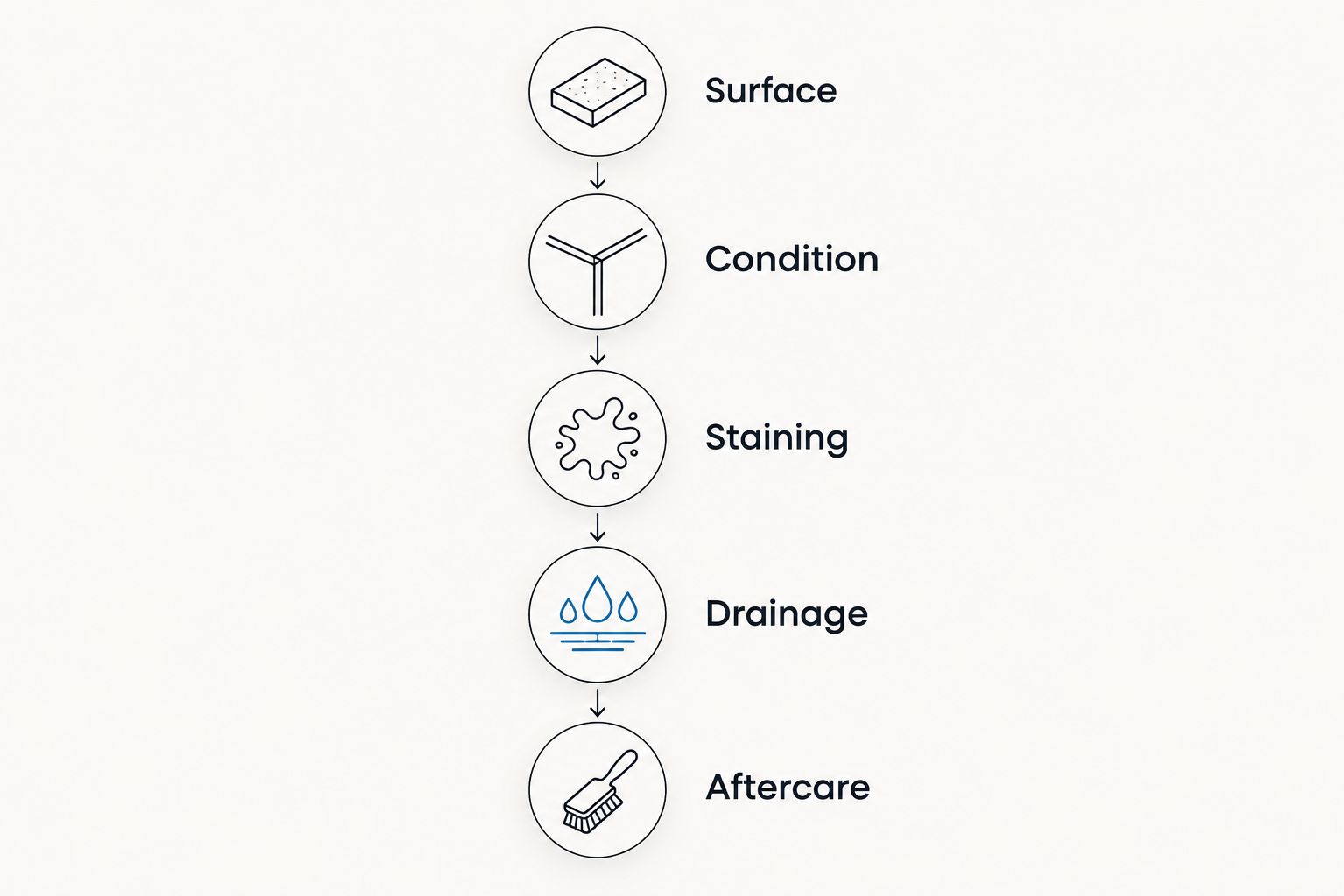
Before requesting driveway cleaning, gather the information that changes the method choice. Ground-level photographs are useful, but they do not replace an on-site assessment where the material or condition is uncertain.
- Surface: describe the material and any known coatings or previous treatments.
- Condition: photograph loose joints, cracks, lifting edges and repaired areas.
- Staining: show close views of green growth, dark marks and vehicle-related stains.
- Drainage: identify pooling, slopes, nearby drains and incoming runoff.
- Aftercare: ask what reinstatement, maintenance and exclusions belong in the written scope.
For a shared or commercial driveway, also identify pedestrian routes, vehicle access and who controls the drainage arrangements. These details belong in job planning, not as assumptions made on arrival.
Send Geyserclean the property address and photographs through the contact page and request a written quote. Ask for the proposed method, inclusions, exclusions and any necessary follow-up work.
How this ranking works
This ranking prioritises surface compatibility, the cause of staining, joint condition, water management and aftercare. It is a decision guide, not a measured trial showing that one method remains clean for a fixed number of months.
For this 2026 comparison, the complete plan ranks above individual methods because it accounts for more than dirt removal. A softwash, pressure wash or steam clean only earns its place when it addresses the actual condition of the driveway.
Which driveway cleaning method should you choose?
Choose a surface-matched professional clean as the default, then select the treatment around the material and problem. Favour suitable softwashing for biological growth, controlled pressure washing for accumulated surface dirt, and steam only where heat has a stated purpose.
Do not borrow guarantees from other services. Geyserclean's roof guarantee is a 3–5 year no-moss guarantee, and its render guarantee is 2 years. Neither establishes a driveway cleaning guarantee or a blanket workmanship guarantee.
FAQ
What's the best driveway cleaning method in Milton Keynes?
The best driveway cleaning method matches the surface, its condition and the type of contamination. For driveway cleaning in Milton Keynes, ask for a written scope covering the method, joint condition, runoff and aftercare rather than choosing equipment alone.
Which driveway cleaning method lasts the longest?
There is no universal longest-lasting driveway cleaning method. Surface condition, shade, recurring contamination, drainage and maintenance affect how quickly the driveway looks dirty again.
Is softwashing better than pressure washing for a driveway?
Softwashing is better suited to some biological-growth problems, while controlled pressure washing suits accumulated dirt on compatible, sound surfaces. Neither is automatically suitable for every driveway, and either approach needs a material and condition assessment.
Does steam cleaning keep a driveway clean for longer?
Steam cleaning does not establish a longer-lasting result by itself. Heat must have a defined purpose for the surface and contamination, while recurring dirt sources and maintenance still need attention.
Will block paving need re-sanding after cleaning?
Block paving needs joint assessment after cleaning, with suitable sand reinstated where joints have lost it. Ask whether this work is included and how the contractor will judge that the paving is ready for reinstatement.
Can driveway cleaning remove every oil stain?
Complete oil-stain removal is not guaranteed by a general driveway clean. Tell the contractor about the stain before quoting so the proposed treatment and its limitations can be explained.
Does the roof no-moss guarantee cover driveway cleaning?
No, the roof no-moss guarantee does not establish cover for driveway cleaning. The stated roof guarantee is 3–5 years and the render guarantee is 2 years; request any driveway-specific terms in writing.
What should I send when asking for a driveway cleaning quote in 2026?
Send your property address, overall driveway photographs and close-ups of stains, joints and damaged areas. Include known surface details, access restrictions and places where water pools so the written quote addresses the actual job.
One last thing
Photograph the driveway when it is dry as well as wet. A wet finish can make colours look deeper and obscure differences you want the contractor to assess. Dry photographs give you a clearer reference for discussing the result and any remaining marks.