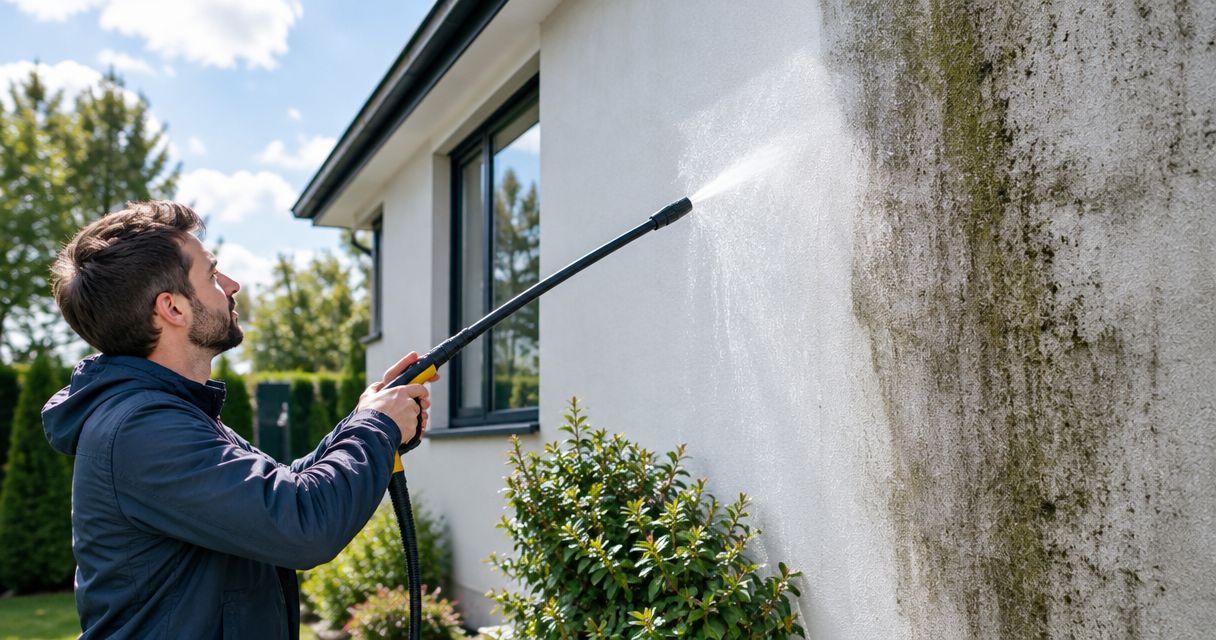
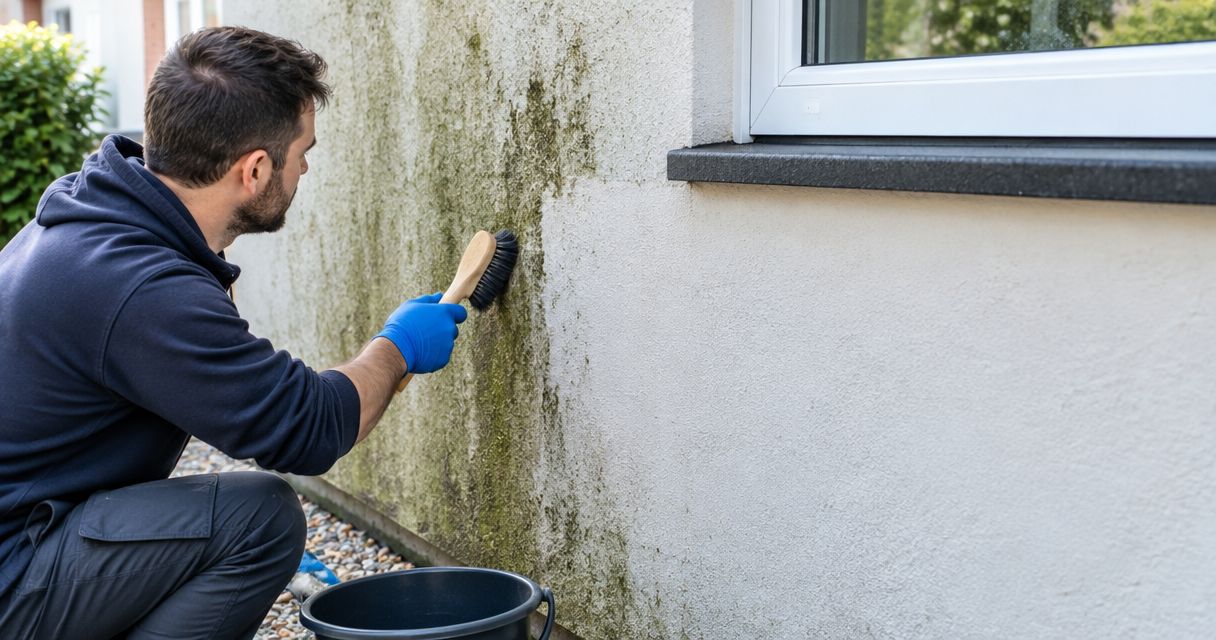
Best starting point for biological staining: professionally assessed softwashing. Best alternative where the finish permits heat: controlled steam cleaning. Best for small, accessible patches: gentle hand cleaning with a compatible treatment. To remove black algae from render, identify the staining and check the surface before choosing the method.
- To remove black algae from render, consider softwashing first, subject to surface condition and treatment compatibility.
- Controlled steam cleaning is an alternative, not a default for every rendered wall.
- Gentle hand cleaning suits small, accessible patches; it is not a whole-building solution.
- Geyserclean provides render cleaning in Milton Keynes; request a surface-specific written quote.
Why this matters
Black and green marks do not identify themselves. Biological growth, dirt, staining beneath an overflow and deterioration of the finish can look similar from ground level. Cleaning the wrong problem wastes effort; increasing pressure does not resolve that mistake.
For homeowners comparing options in 2026, the useful question is not which machine cleans hardest. It is which method suits the render, its coating, its age and its present condition. Geyserclean provides professional render cleaning alongside roof cleaning, gutter clearance, driveway cleaning and patio cleaning in Milton Keynes and the surrounding Home Counties.
Geyserclean is a render cleaning option for Milton Keynes property owners seeking a professional assessment rather than a one-method prescription.
What makes the best render-cleaning method?
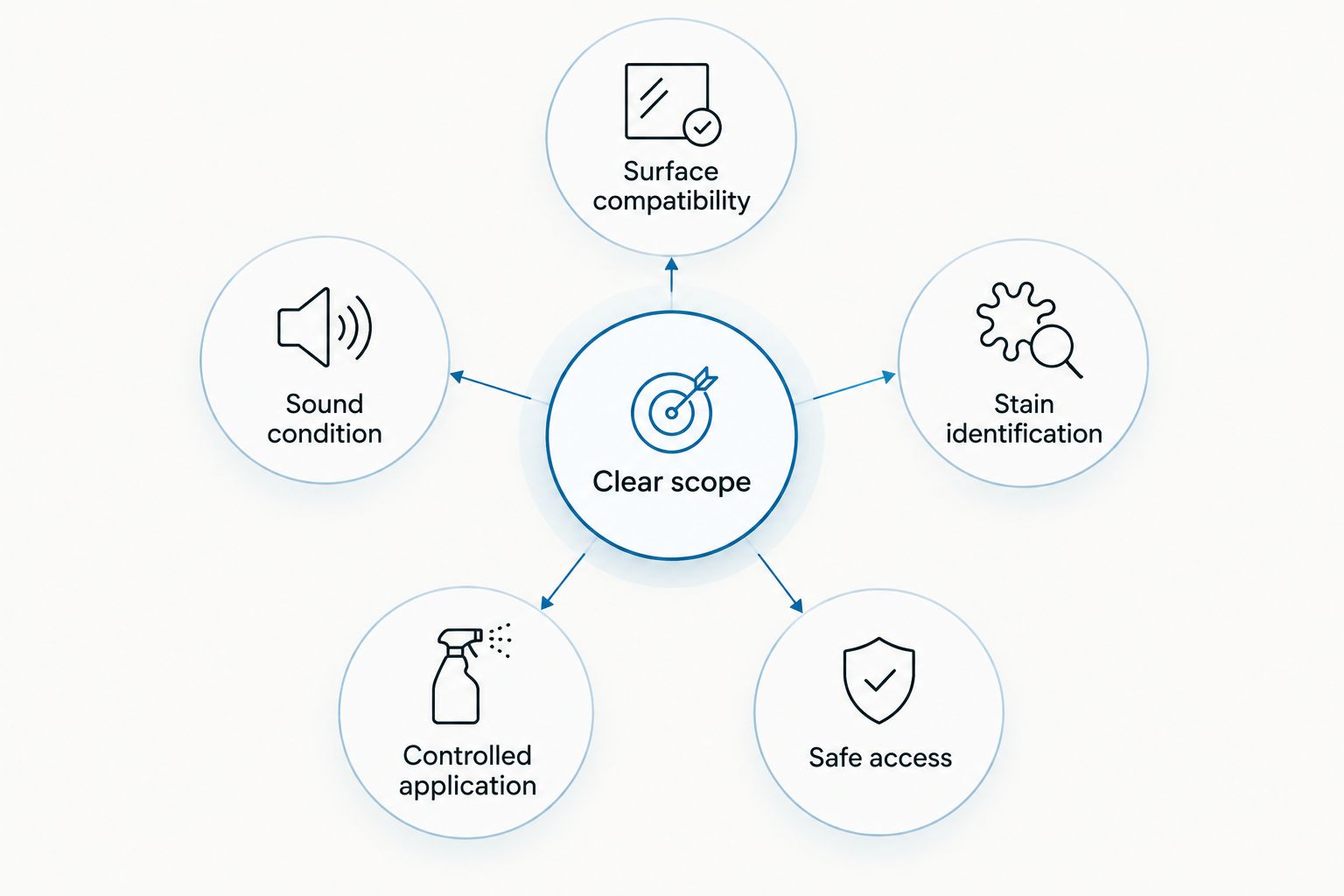
Use these criteria before comparing the options. A method that fails the first two checks should not win because it looks quicker.
- Surface compatibility: identify the render system and any paint or protective coating; check the relevant care guidance.
- Sound condition: inspect cracks, loose areas, damaged edges and existing water-entry points before cleaning.
- Stain identification: distinguish suspected biological growth from dirt, rust marks and coating failure.
- Controlled application: assess pressure, heat, treatment compatibility and runoff together, not separately.
- Safe access: account for upper walls, conservatories, neighbouring boundaries, plants and people below.
- Clear scope: record what is being cleaned, what remains excluded and what happens if a test area responds poorly.
A test patch helps establish how the surface responds. It does not turn an unsuitable treatment into a suitable one, and it does not replace checking the manufacturer's instructions.
Render-cleaning methods at a glance
This 2026 comparison ranks methods by their role in treating stained render, not by cleaning strength. Each option has a different use case; none overrides the condition of the wall.
| Method | Best for | Standout feature | Key limitation |
|---|---|---|---|
| Professionally assessed softwashing | Widespread biological staining on compatible render | Treatment-led cleaning without relying on aggressive mechanical force | Treatment selection and runoff need careful control |
| Controlled steam cleaning | Suitable surfaces where a heat-assisted method is justified | Combines heat with controlled cleaning | Heat and moisture are not suitable for every finish |
| Gentle hand cleaning | Small, safely accessible patches | Close control over a limited area | Impractical for extensive or high-level staining |
These are alternatives, not a sequence you must apply to every wall. Combining methods requires the same compatibility checks as choosing a single method.
1. Softwashing: best for widespread biological staining
Softwashing uses a cleaning treatment applied at low pressure. Where algae or other biological growth is confirmed and the render is compatible, it addresses the contamination without making high-pressure impact the main cleaning mechanism.
The treatment, application process and any rinsing must suit the finish. A label saying softwash does not establish that a particular chemical or procedure is safe for your wall.
Softwashing pros:
- Suits treatment-led cleaning of widespread biological staining on compatible surfaces.
- Reduces reliance on forceful water impact to remove visible growth.
- Allows the treatment approach to be matched to the identified contamination.
Softwashing cons:
- Requires compatible chemistry and careful protection of surrounding areas.
- Does not repair cracks, failed coatings or sources of persistent dampness.
- Does not guarantee removal of every dark mark, particularly where the cause is not biological.
Best for: homeowners with widespread green or black biological staining on sound render that is suitable for the proposed treatment.
Ask how plants, adjacent materials and runoff will be managed. Also ask what the contractor expects to remain after cleaning; an honest answer separates removable growth from permanent discolouration or surface defects.
For a method-specific comparison, read how soft wash render cleaning differs from pressure washing.
Verdict: Choose professionally assessed softwashing as the starting option for compatible render with biological staining.
2. Controlled steam: best for suitable heat-tolerant finishes
Controlled steam cleaning uses heat as part of the cleaning process. It is an alternative where the surface condition, finish and contamination justify it, not proof that every rendered wall should be steamed.
The contractor needs to explain why heat is appropriate and how application will be controlled. Calling a process steam cleaning does not remove the need to assess moisture entry, coatings and vulnerable details.
Controlled steam cleaning pros:
- Offers a heat-assisted alternative where the render system permits it.
- Allows the contractor to assess a different approach when treatment-led cleaning is unsuitable.
- Provides a method that can be evaluated on a small trial area before wider work.
Controlled steam cleaning cons:
- Heat is not compatible with every coating or surface condition.
- Moisture still needs controlling around cracks, joints, vents and openings.
- A visually cleaner surface does not establish that the cause of recurring staining has been resolved.
Best for: property owners whose sound render has been assessed as suitable for controlled heat-assisted cleaning.
Do not transfer a roof-cleaning specification to the walls. Roof tiles, render, painted trim and sealants are different materials, even when they are being cleaned during the same visit.
Verdict: Hold until surface suitability is confirmed; choose steam only when the assessment supports it.
3. Gentle hand cleaning: best for small accessible patches
Gentle hand cleaning gives you close control over a limited area. A compatible treatment, soft implement and any permitted rinsing must follow the surface and product instructions; abrasive scrubbing is not the same method.
This option is about scale and access, not a promise that household cleaning products are suitable. Stop if the surface powders, sheds material or changes appearance during the trial.
Gentle hand cleaning pros:
- Allows close observation of a small affected patch.
- Keeps the initial working area limited.
- Avoids introducing powered cleaning equipment where it is unnecessary.
Gentle hand cleaning cons:
- Is unsuitable for work that requires unsafe reaching or improvised access.
- Can leave uneven results across a larger elevation.
- Repeated rubbing can affect a vulnerable finish, even without powered equipment.
Best for: isolated staining you can reach safely, where the render manufacturer's guidance permits the proposed cleaning approach.
Never mix cleaning chemicals or assume that a product intended for paving suits render. Protect yourself and surrounding areas according to the product instructions, and leave uncertain or extensive staining to a professional assessment.
Verdict: Choose only for small, accessible, compatible areas; skip abrasive scrubbing.
Why high-pressure washing is not the default
Pressure washing is not interchangeable with softwashing. It relies more heavily on mechanical cleaning, so the surface, equipment settings, nozzle and working technique matter.
For black and green staining on render, do not choose a contractor simply because the equipment removes marks quickly. Ask whether the render manufacturer permits the proposed method and how the contractor will avoid disturbing the finish or driving water into existing defects.
The right pressure is the pressure permitted by the surface and the cleaning specification, not the highest setting available. Damaged or unidentified render needs assessment before a powered method is selected.
Check the wall before treating the stain
A dark streak beneath a gutter deserves a different investigation from evenly spread green growth on a shaded wall. Look for the pattern and the water source before agreeing to clean the whole elevation.
For your 2026 maintenance plan, separate these jobs:
- Roof cleaning: assess roof growth and the roof material independently; do not assume the render-cleaning method applies above it.
- Gutter clearance: investigate debris and overflow where staining starts below the gutter line.
- Gutter repairs: investigate leaks, displaced joints or other defects rather than treating clearance as a repair.
- Render cleaning: choose the cleaning method after identifying the finish and inspecting its condition.
- Driveway and patio cleaning: specify these separately because paving, joints and wall finishes need different treatment decisions.
For managed blocks and commercial premises, also establish access permissions and how people will be kept away from the working area. A clear cleaning scope should include practical access arrangements, not just the area of wall.
What to send for a written quote
Send the property address and 3 photographs as a useful starting set: one showing the whole elevation, one close-up of the staining and one showing access below it. These are recommended views, not a substitute for an inspection where one is needed.
Include the render type if known, previous painting or cleaning, visible damage and any gutters that overflow. Say whether the request covers render alone or includes roof cleaning, gutter clearance, driveway cleaning or patio cleaning.
Your 2026 quote comparison should answer these questions:
- What does the contractor believe is causing the staining?
- Which method is proposed, and why does it suit this surface?
- What preparation, protection, cleaning and rinsing are included?
- What existing defects or permanent marks are excluded?
- What happens if the test patch shows an unsuitable response?
- What guarantee applies to this particular service?
Geyserclean's render guarantee is 2 years. Its roof offer is a separate 3–5 year no-moss guarantee, not a blanket workmanship guarantee or a render guarantee; request the applicable written terms with the quote.
Request a written cleaning quote
Send your property address and photos, including staining, wall condition and access.
How these methods are ranked
The order follows surface compatibility, condition, stain identification, control and access. Softwashing leads for confirmed biological staining on compatible render; steam serves a narrower, assessment-led role; hand cleaning serves small accessible areas.
This is a decision guide, not a report of product testing or a claim that one treatment suits every property. A failed compatibility check overrides the ranking.
Which method should you choose?
Start with a professional assessment for softwashing if your main problem is widespread biological staining on otherwise sound render. Choose controlled steam only where the finish and condition support it, and reserve hand cleaning for genuinely small, safely accessible patches.
For a 2026 cleaning enquiry, give Geyserclean the property address, photographs and any known surface details. Ask for a written method and scope rather than requesting a particular machine before the wall has been assessed.
FAQ
What's the best way to remove black algae from render?
Professionally assessed softwashing is a useful starting option for confirmed biological staining on compatible, sound render. Check the render type, coating and condition before selecting a treatment; black marks alone do not confirm algae.
Is steam cleaning better than softwashing for render?
Neither method is better for every rendered wall. Softwashing is treatment-led, while steam introduces heat; the surface specification and condition determine which approach is appropriate.
Can I pressure wash black marks off my rendered house?
Do not make pressure washing the default for an unidentified or damaged render finish. Check the manufacturer's guidance and obtain a surface-specific method before using powered cleaning equipment.
Can I clean a small green patch myself?
Gentle hand cleaning is an option only where the patch is safely accessible and the surface guidance permits the treatment. Trial a small area, follow product instructions and stop if the finish deteriorates.
Will render cleaning remove every black stain?
Render cleaning does not guarantee removal of every black stain. Biological growth, embedded discolouration, rust and coating defects require different assessments, and some marks need work beyond cleaning.
Should gutters be checked before render cleaning?
Check gutters where staining follows overflow or leakage patterns. Clearing debris and repairing a leaking joint are different jobs, and cleaning the wall alone does not resolve either cause.
What guarantee does Geyserclean offer for render cleaning?
Geyserclean's render guarantee is 2 years. The separate roof guarantee is a 3–5 year no-moss guarantee; request the written terms for the service being quoted.
One last thing
Photograph the staining before anyone wets the wall. Water changes how a finish looks, so dry overview and close-up photographs give you a clearer record of the original marks and existing defects.
Then send the address and photographs for a written quote. Choose the explanation that fits your wall, not the strongest-sounding cleaning method.